
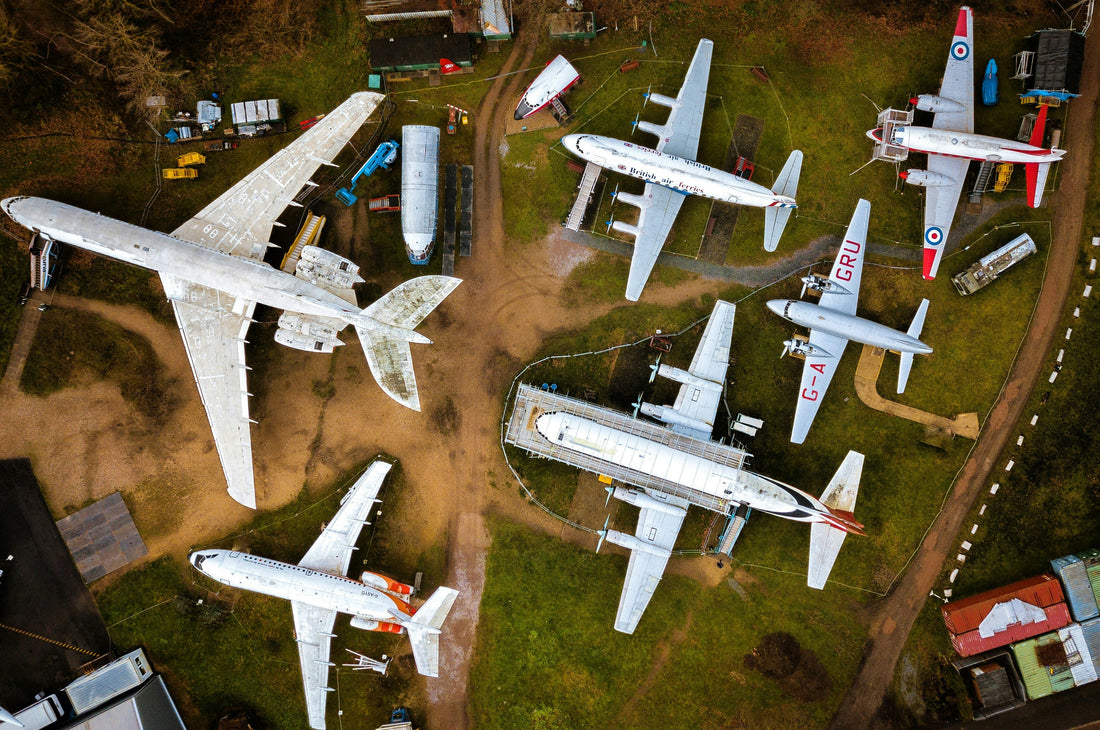
What happens to planes at the end of their life?
Partager
Every airplane has a story. After thousands of hours flying around the world, even the most majestic giants of the sky must eventually retire. But what happens to an airplane when it no longer carries passengers? Contrary to what one might think, their end-of-life is far from sad or useless.
When an airplane reaches the end of its career
The average lifespan of a commercial airliner is between 20 and 30 years, depending on its use, maintenance, and the airline operating it. Over time, maintenance costs increase, environmental standards become stricter, and newer, more fuel-efficient models become more profitable.
When an aircraft is no longer deemed profitable or safe, it is "retired from service." This process is far from improvised: it is a planned procedure, overseen by aeronautical authorities and airlines.
The long journey to aircraft boneyards
Once decommissioned, most aircraft are not immediately destroyed. They head to aircraft boneyards, often located in desert regions like the Mojave Desert in the United States or Tarbes in southern France.
These places, with their dry, humidity-free climates, allow aircraft to be stored without corrosion setting in. Some wait there to be sold, dismantled, or simply "mothballed" pending a potential resumption of air traffic.
Walking among these sleeping giants, lined up as far as the eye can see, is somehow fascinating — almost melancholic.
Recycling: a second life for aircraft
But most aircraft do not stay in the desert forever. Many are dismantled piece by piece to recover anything that can be reused.
Engines, landing gear, cockpit screens, and even seats can be refurbished and resold. Materials such as aluminum, titanium, and wiring are recycled for other industrial uses.
Today, over 85% of an aircraft can be recycled — a true technological and ecological achievement.
When aircraft transform
Some aircraft, instead of being dismantled, embark on a much more unusual second career.
A Boeing 727 transformed into a restaurant, an Airbus A340 becoming a luxury hotel in Sweden, or an old cargo plane converted into a flight simulator for student pilots: examples are plentiful.
Others end up in aerospace museums, where they continue to amaze visitors. It's a beautiful way to extend their story, even when grounded.
A major ecological and economic challenge
Aircraft dismantling is not just a matter of passion: it is also an environmental issue.
Programs like PAMELA (Process for Advanced Management of End-of-Life of Aircraft) and AFRA (Aircraft Fleet Recycling Association) work to make aircraft recycling more sustainable and profitable.
The goal? Reduce waste, valorize materials, and create a circular economy around aviation.
What once ended up in the scrapyard is now a valuable resource.
Conclusion: the end of the flight... but not the end of the story
When an airplane retires, it doesn't truly disappear. Whether recycled, transformed, or exhibited, it continues to tell a part of aviation's history.
And somewhere, in a scorching desert or a museum full of awestruck children, these giants of the sky continue to inspire dreams.
Watch a video about the end-of-life of airplanes:
FAQ: We answer all your questions
What is the average lifespan of an aircraft?
Generally, an airliner flies for 20 to 30 years before being retired from service.
Where do aircraft go once retired?
They are sent to storage areas called aircraft boneyards, often located in dry deserts to prevent corrosion.
Can you visit an aircraft boneyard?
Yes, some, like those in Mojave or Tarbes, can be visited on organized tours.
What happens to aircraft metal after dismantling?
It is melted down and reused in industry, particularly for construction, automotive, or even new aircraft.
Are there aircraft transformed into hotels or restaurants?
Yes, several aircraft have been converted into unusual places such as hotels, bars, or museums around the world.
Fly-by-wire aircraft: revolution or calculated risk?