
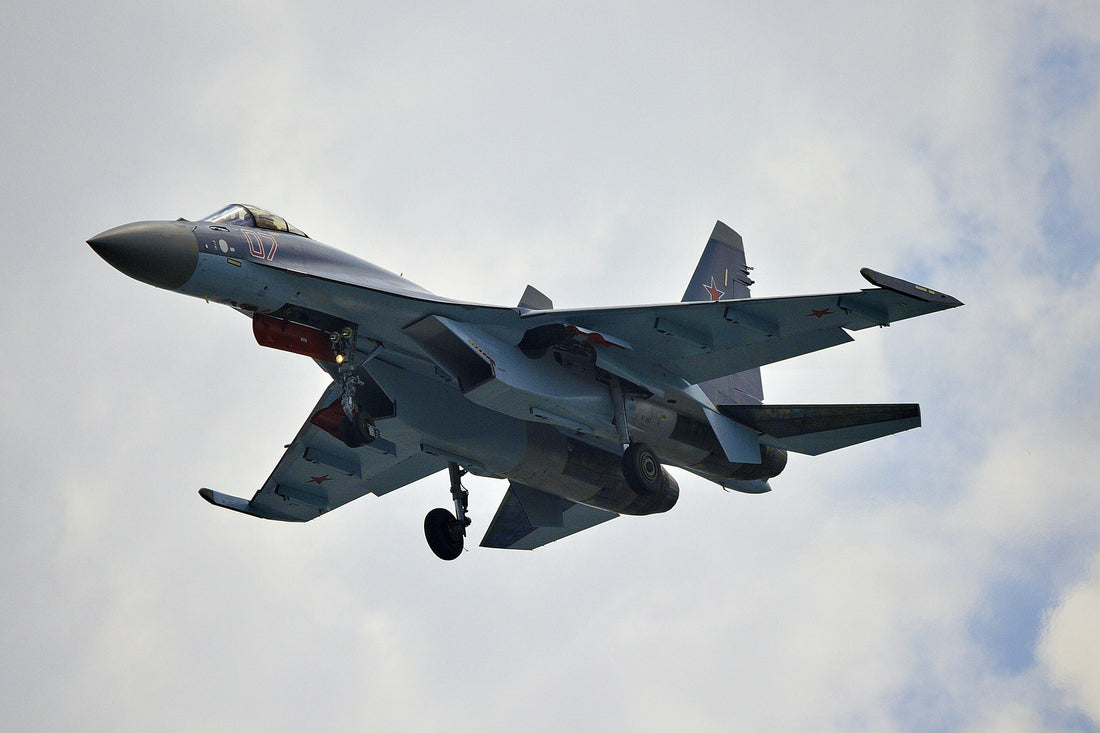
The Story of the Sukhoi Su-35: An Exceptional Russian Fighter Jet
Partager
In the world of military aviation, some fighter jets leave a lasting impression due to their power, elegance, or eventful history. The Sukhoi Su-35 undoubtedly belongs to this category. A direct evolution of the legendary Su-27, this 4++ generation multirole fighter is now one of the flagships of the Russian aerial arsenal. Designed to compete with the most advanced Western aircraft, the Su-35 embodies Moscow's modernized vision of air superiority.
But behind its aggressive lines and impressive technical specifications lies a long, complex, and sometimes chaotic history. Let's look back at the journey of this unique aircraft.
The origins of the Su-35: an heir to the Su-27
A need for modernization in the late 1980s
In the late 1980s, the Soviet Union sought to modernize its air fleet in the face of rapid developments in Western aviation. The Su-27, already very high-performing, needed to be improved to maintain an advantage in air combat. It was in this context that the Su-27M project emerged, laying the groundwork for what would later become the Su-35.
The Su-27M: an ambitious but unfinished prototype
Sukhoi engineers then developed several prototypes designated T10M, incorporating many innovations for the time: thrust vectoring, modernized cockpit, improved radar... However, despite its qualities, the program suffered from the collapse of the USSR and the economic difficulties of the 1990s. It was put on hold, or even abandoned. But the idea was not dead.
The return of the Su-35: a renaissance in the 2000s
A discreet but strategic relaunch
In the early 2000s, as the Russian economy regained some dynamism, the idea of modernizing the Su-27 resurfaced. This time, it was no longer about taking up the Su-27M as it was, but about creating a true multirole fighter, capable of carrying out varied missions in an increasingly complex technological environment. The project then took on a new name: Su-35BM (for "Bolshaïa Modernizatsiya", or "great modernization").
Birth of the modern Su-35
The new aircraft differs significantly from the original Su-27, both in its avionics and its performance. Faster, more agile, better armed, and equipped with a latest-generation radar system, the Su-35S officially entered production in the early 2010s. It is not stealthy, but it largely compensates with its firepower and exceptional maneuverability.
Impressive performance for a non-stealth aircraft
Speed, maneuverability, and range
The Su-35 is capable of flying at Mach 2.25, with a combat radius exceeding 3,500 km without refueling. Thanks to its optimized airframe and thrust-vectoring engines, it offers remarkable agility, especially in close-range combat.
Radar and armament: a formidable arsenal
One of the major assets of the Su-35 lies in its Irbis-E radar, capable of detecting targets at very long range, even with a low radar signature. It can track up to 30 targets simultaneously and engage 8 at the same time.
In terms of armament, it carries a wide variety of air-to-air missiles (such as the R-77 or R-73), as well as air-to-ground missiles and guided bombs. It is also equipped with a 30 mm GSh-30-1 cannon for close-range combat.
The Su-35 in operation: Syria, Ukraine, and beyond
Entry into service in the Russian army
The Su-35 was officially integrated into the Russian Air Force from 2014, progressively replacing older Su-27s. Several fighter regiments have been re-equipped with this model, particularly in the Russian Far East and the Arctic.
First engagements: Syria as a testing ground
The first major theater of operations for the Su-35 was the war in Syria, where several aircraft were deployed from 2016. Their role was primarily to ensure air superiority and the protection of Russian bombers operating against ground targets. This operation allowed Moscow to demonstrate the capabilities of its new aircraft to the world.
War in Ukraine and strategic stakes
More recently, the Su-35 has been engaged in the conflict in Ukraine, where it has carried out air defense and deep strike missions. However, the losses incurred and its performance against Ukrainian defenses have raised some questions about its true effectiveness in a contested environment.
The Su-35 for export: partial international success
Despite its qualities, the Su-35 has not become as widespread as some competitors on the global market. However, several countries have placed orders, including:
-
China, with 24 units delivered as early as 2016.
-
Egypt, which signed a contract in 2018 (although deliveries have been delayed).
-
Indonesia, which showed interest but faced international pressure to cancel the purchase.
The main obstacle often remains political or diplomatic, particularly US sanctions imposed on countries purchasing Russian military equipment.
Criticisms and limitations of the Su-35
Despite its effectiveness, the Su-35 is not without its flaws. Its airframe, though modernized, is still derived from a design dating back to the 1980s. It is not stealthy, which makes it more vulnerable against adversaries equipped with advanced radars.
Furthermore, maintaining the aircraft is complex and costly, particularly due to its sophisticated onboard systems. Finally, with the arrival of the Su-57, its stealthy successor, some analysts believe that the Su-35's role could decline in the coming decades.
Discover the Su-35 model
What future for the Su-35?
Despite uncertainties, the Su-35 still has many good years ahead of it. It will likely continue to play a central role in Russian air defense, complementing fifth-generation fighters. It could also attract new customers in regions of the world less subject to American influence.
Its versatility, power, and autonomy make it a formidable aircraft in today's skies.
Conclusion
The history of the Sukhoi Su-35 is that of an aircraft born in pain, but which has earned its place among the most powerful fighters of its generation. Heir to a prestigious Soviet past, it embodies both the continuity and innovation of the Russian aviation industry.
Whether one admires its capabilities or criticizes its limitations, one thing is certain: the Su-35 has marked the history of military aviation, and its roar in the sky will continue to resonate for a long time.
Watch a video about the history of the Sukhoi Su-35:
FAQ: We answer all your questions
What is the difference between the Su-35 and the Su-27?
The Su-35 is a deeply modernized version of the Su-27, with a more powerful radar, thrust-vectoring engines, and much more advanced avionics.
Is the Su-35 stealthy?
No, the Su-35 is not a stealth aircraft. It relies instead on its maneuverability, radar power, and speed to dominate its adversaries.
How much does a Su-35 cost?
The unit cost is estimated between 65 and 85 million dollars, depending on the configuration and bilateral agreements.
Which countries use the Su-35?
Mainly Russia, but also China and potentially Egypt. Other countries such as Iran or Venezuela have shown interest.
1 comment
Vous avez oublié de cité l’Algérie comme utilisateur du su 35 la commande qui été prévu pour l’Égypte l’Algérie la récupérer en 2025