
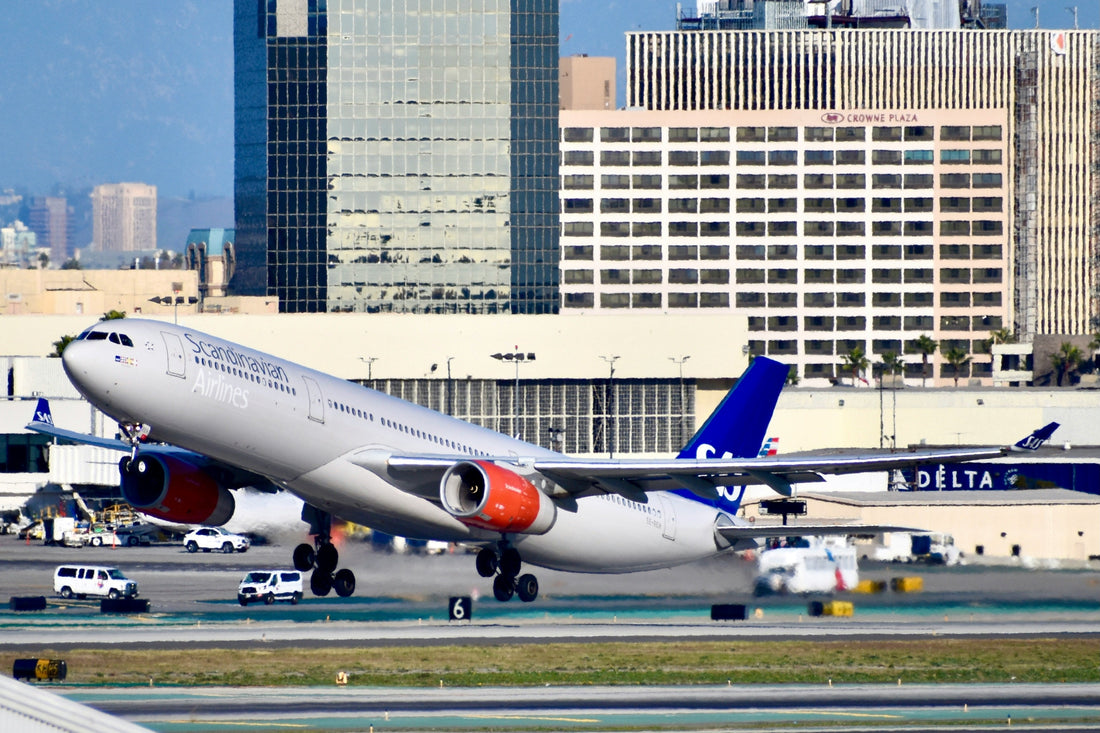
The History of the Airbus A330
Partager
Since its appearance in the 1990s, the Airbus A330 has established itself as one of the pillars of long-haul air transport. Thanks to its reliability, adaptability, and comfort, it continues to connect continents today, more than three decades after its first flight. But how did this aircraft become such a success? Let's take a look at the fascinating history of the A330.
Project origins: meeting a growing need
The 70s-80s context
In the late 1970s, the aviation market was booming. Airlines were looking for aircraft capable of transporting a large number of passengers over long distances, while reducing operating costs. At that time, Airbus was starting to make a name for itself against the giant Boeing, but still needed to convince major international airlines.
It was in this context that the idea of a modern, long-range twin-engine aircraft, more economical than the four-engine aircraft then in service, was born.
The launch of the A330 program
Airbus officially launched the A330 program in the late 1980s, simultaneously with the A340, with which it shares a large part of its design. The objective was clear: to offer a versatile aircraft, capable of covering most long-haul routes with reduced fuel consumption. The A330 was designed from the outset to be scalable, with different versions adapted to the needs of airlines.
First flight and entry into service
The inaugural flight in 1992
On November 2, 1992, the A330 made its first test flight from Toulouse. This flight marked the beginning of a new era for Airbus. The aircraft impressed with its maneuverability and efficiency. Tests followed rapidly, leading to certification in 1993.
First customers and entry into service
The first airline to operate the A330 was Air Inter, quickly followed by Air France and other major airlines. Thanks to its spacious cabin and comfortable range, the aircraft quickly found its place on routes connecting Europe to America, Asia, and Africa.
A330 developments and variants
The A330-300: the original model
The A330-300 is the first commercialized model. It offers a capacity of up to 440 passengers and a range of approximately 11,750 km. It is an ideal aircraft for high-traffic routes, offering interesting profitability for airlines.
The A330-200: more compact, more enduring
To meet the demand for an aircraft better suited to long but less frequented routes, Airbus developed the A330-200. It is shorter than the -300, but has a greater range (up to 13,450 km). It quickly became popular with carriers looking to operate intercontinental flights with maximum flexibility.
The A330 MRTT: the military version
The A330 also found a second life in the military sector. The MRTT (Multi Role Tanker Transport) model is designed for aerial refueling and troop transport. It is currently used by several armies around the world, including those of France, the United Kingdom, and Australia.
The A330neo: the modernization of a best-seller
In 2014, Airbus decided to modernize its flagship aircraft to make it even more efficient. This led to the birth of the A330neo (New Engine Option), available in two versions: A330-800 and A330-900.
Significant improvements
The main change lies in the engines: the new Rolls-Royce Trent 7000 allows for a reduction in fuel consumption of nearly 25% compared to previous versions. The aircraft is also equipped with new Sharklets, optimized aerodynamics, and a quieter, more modern cabin, called Airspace.
The A330neo entered service in 2018, with TAP Air Portugal as its first operator. It quickly attracted several airlines thanks to its efficiency and comfort.
An undeniable global success
The Airbus A330 is now one of the best-selling long-haul aircraft in history. With over 1,500 units delivered, it is present in the fleets of many major airlines such as Delta Air Lines, Emirates, Lufthansa, and Turkish Airlines.
Its controlled operating cost, reliability, and adaptability have largely contributed to its success on all continents.
Discover an A330 model
A still promising future
Despite the arrival of newer models such as the Airbus A350 or the Boeing 787, the A330 continues to attract. Its neo version offers an ideal transition for airlines seeking to modernize their fleet without switching to entirely new aircraft. Moreover, the A330-200 remains today one of the best compromises for passenger transport, cargo, or governmental uses.
In a context where airlines seek to optimize every flight, the A330 retains a prominent place, including for conversions into cargo aircraft.
Conclusion
The Airbus A330 alone embodies several decades of civil aviation evolution. Designed from the outset to meet economic and technological challenges, it has adapted, evolved, and reinvented itself. Even today, it flies above our heads, connecting peoples and cultures, with the promise of a comfortable and reliable flight.
Its history is that of a successful industrial gamble, which has become one of Airbus's greatest successes.
Watch a video about the history of the Airbus A330:
FAQ: we answer all your questions
When was the Airbus A330 launched?
The program was launched in the late 1980s, and the first flight took place in November 1992.
What is the difference between the A330-200 and the A330-300?
The A330-200 is shorter but has a longer range, making it better suited for long distances.
How many A330s have been produced?
To date, over 1,500 units have been delivered worldwide.
What is the A330neo?
It is a modernized version of the A330 with new engines, improved aerodynamics, and a redesigned cabin.
Is the A330 still in production?
Yes, particularly its A330neo version, which remains highly sought after for its energy performance.
The history of the A220: From Bombardier to Airbus, the rebirth of a revolutionary aircraft