
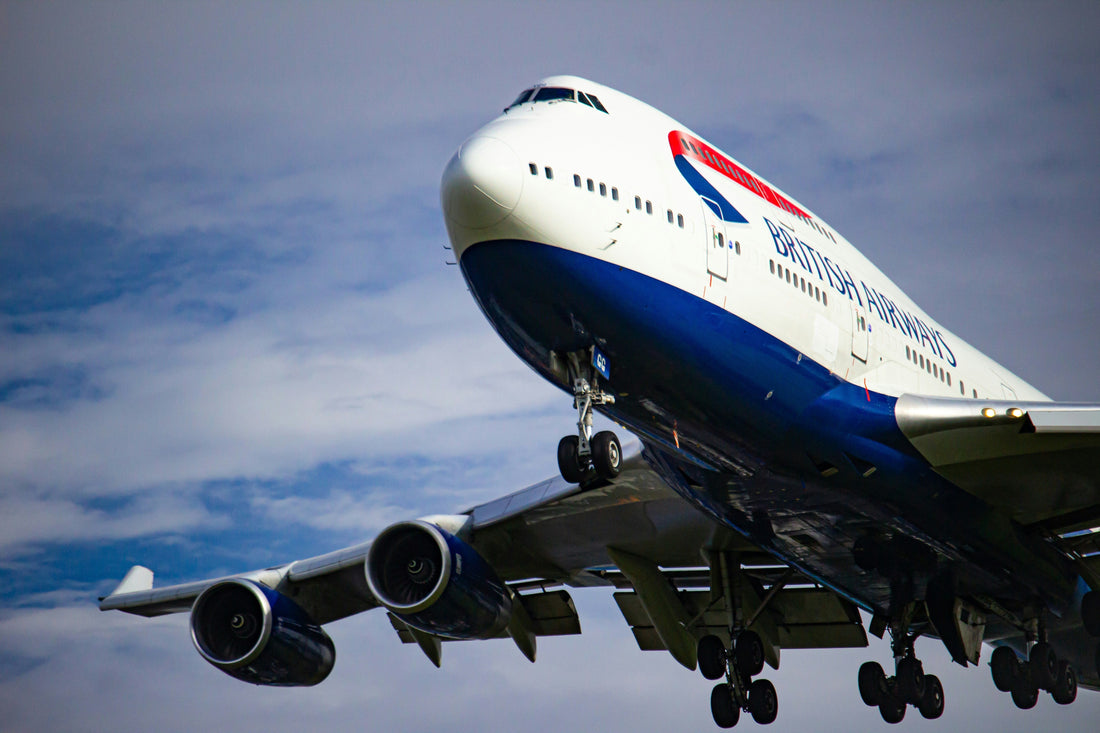
Speed of commercial aircraft
Partager
When you fly, you often feel like you're speeding through the clouds. But what is the actual speed of an airliner? Between the figures announced by airlines and the reality in flight, it can sometimes be confusing. In this article, we'll look at how fast commercial airplanes fly, what influences their speed, and why they don't go even faster. Buckle up, we're taking off!
Introduction
Speed is a key element in commercial aviation. The faster an aircraft flies, the further it can travel in less time, which is essential for airlines and passengers. But behind this simple notion lie many factors: the type of aircraft, altitude, weather conditions, etc.
In this article, we will explore the speed of airliners from all angles. What is their average speed? Why don't they go faster? And most importantly, what will aviation of the future look like in terms of speed? Answers right away!
Factors influencing the speed of airliners
The speed of an airliner does not depend solely on its power or model. Several elements come into play and can change it during flight.
Aircraft type
Not all airliners fly at the same speed. A short-haul aircraft like the Airbus A320 or the Boeing 737 has a lower cruising speed than a long-haul aircraft like the Boeing 787 or the Airbus A350. Aircraft designed for long distances are optimized to fly faster and more efficiently at high altitudes.
Weather conditions
Wind plays a major role in an aircraft's speed. A tailwind can add several tens of kilometers per hour, while a headwind slows it down. The jet stream, a powerful high-altitude air current, is often used by pilots to reduce flight time on certain routes.
Cruising altitude
The higher an aircraft climbs, the thinner the air, which reduces drag and allows it to fly faster while consuming less fuel. However, there is a limit: too high, the engines would lose efficiency and wing lift would decrease, making the flight unstable. This is why every aircraft has an optimal cruising altitude, generally between 9,000 and 12,000 meters.
All these elements combined explain why the speed of an airliner varies from one flight to another, even for the same destination.
Typical airliner speeds
We often hear about the speed of airplanes, but in reality, it can be expressed in several ways. There's ground speed, which depends on the wind, and airspeed, which is the speed at which the aircraft moves through the air. Let's see how fast airliners actually fly.
Commercial aircraft cruising speed
On average, an airliner flies at a cruising speed of between 800 and 900 km/h. Here are some concrete examples:
-
Airbus A320 / Boeing 737 (medium-haul): approximately 830 km/h
-
Boeing 787 / Airbus A350 (long-haul): between 900 and 930 km/h
-
Concorde (supersonic aircraft): approximately 2,180 km/h
These figures are averages, as speed varies depending on flight conditions.
Why does speed change during flight?
During takeoff and landing, an aircraft flies much slower. For example, an Airbus A320 reaches about 250 km/h before leaving the ground. Then, during ascent, it gradually accelerates to its cruising speed.
Another important point: wind. If an aircraft flies at 900 km/h in the air but has a tailwind of 100 km/h, its ground speed will be 1,000 km/h. Conversely, with a headwind of 100 km/h, its ground speed would drop to 800 km/h. This is why flight time can vary depending on the journey, even on the same air route.
In summary, although airliners have standard speeds, several factors can cause them to vary in flight.
Why don't airplanes fly faster?
With technological progress, one might think that airliners would fly faster and faster. However, their speed has remained relatively stable for several decades. Why not go faster and further reduce flight times? Several reasons explain this limitation.
Fuel and costs
Aircraft speed is directly linked to its fuel consumption. The faster an aircraft flies, the more it must overcome air resistance, which significantly increases consumption. However, fuel already represents one of the largest costs for airlines. Finding the right balance between speed and energy efficiency is therefore crucial for the profitability of flights.
Technological and aerodynamic limits
Modern aircraft are designed to be as efficient as possible within their optimal speed range. Going faster would require stronger materials, more powerful engines, and different wings. All of this would make the aircraft heavier and its operation more complex.
Regulations and safety
Commercial aviation is strictly regulated by international standards. Aircraft must comply with speed rules, particularly during approach and descent, to ensure safety in air corridors. Moreover, increasing speed would mean modifying these rules, which would impact global air traffic management.
Ultimately, the current speed of airliners results from a compromise between performance, cost, and safety. As long as technologies do not allow flying faster without major drawbacks, speed will remain close to what it is today.
Discover our airliner models
Towards faster aircraft?
Even if the speed of airliners has not changed much in recent decades, promising projects could well change the situation. Between the return of supersonic aircraft and new technologies, commercial aviation could become much faster in the near future.
The return of supersonic aircraft
The Concorde made history with its flights at over 2,000 km/h, but its operation ended in 2003 due to its high cost and excessive consumption. Today, several companies, such as Boom Supersonic, are working on a new generation of supersonic aircraft, capable of connecting New York to London in just 3 or 4 hours.
These future aircraft, like the Boom Overture, promise to be more economical and quieter than the Concorde, which could revive supersonic transport for commercial flights.
Hypersonic and electric aviation
Even more ambitious, hypersonic aircraft projects aim for speeds of 5,000 to 7,000 km/h, which would allow crossing the planet in just a few hours. Companies like Hermeus and agencies like NASA and ESA are exploring this avenue, although these technologies are not yet ready for commercial use.
In parallel, electric aviation and alternative fuels are under development. While these technologies do not necessarily aim to increase speed, they could revolutionize the way we travel by making airplanes more environmentally friendly and cost-effective.
A faster future?
Will airliners soon fly as fast as rockets? Not yet. But with advances in materials, aerodynamics, and propulsion, air travel could become much faster in the coming decades. It remains to be seen whether these innovations will be accessible to the general public!
Conclusion
The speed of airliners is a fascinating topic that combines technology, economics, and regulatory constraints. Today, commercial aircraft generally fly between 800 and 900 km/h, an ideal compromise between speed, fuel consumption, and safety.
While much faster aircraft could be imagined, several limitations explain why speed has not evolved much in recent years. However, with the return of supersonic aircraft and advances in hypersonic aviation, the future may hold some surprises.
So, will we one day see planes capable of taking us to the other side of the world in a few hours? Only time will tell. In the meantime, technology continues to evolve, and who knows, perhaps the air travel of the future will be much faster than we imagine today!
Watch a video on different speeds in aeronautics:
FAQ: We answer all your questions
What is the average speed of an airliner?
The average cruising speed of an airliner is generally between 800 and 900 km/h. However, this depends on the type of aircraft and flight conditions.
What is the takeoff speed of an A380?
The takeoff speed of an Airbus A380 is approximately 280 km/h. However, this speed may vary slightly depending on weather conditions and aircraft weight.
What is the takeoff speed of a Boeing 747?
The takeoff speed of a Boeing 747 is generally around 250 to 280 km/h. As with the A380, this can vary depending on flight conditions and aircraft weight.
What is the maximum speed of an Airbus A320 airliner?
The maximum speed of an Airbus A320 is approximately 870 km/h (Mach 0.82). However, this speed is rarely reached in commercial flight, as the aircraft generally flies at a lower cruising speed to optimize fuel consumption and ensure safety.
What is the speed record for a piloted aircraft?
The speed record for a piloted aircraft is held by the North American X-15, an experimental aircraft. It reached an impressive speed of 7,274 km/h (Mach 6.72) in 1967, piloted by astronaut William J. "Pete" Knight. This record remains unequaled for a piloted aircraft to this day.
What is the maximum speed of an Airbus A350?
The maximum speed of an Airbus A350 is approximately 1,050 km/h (Mach 0.89). However, in commercial flight, the aircraft generally flies at a lower cruising speed to optimize fuel efficiency.
What is the maximum speed of a Boeing 737?
The maximum speed of a Boeing 737 is approximately 870 km/h (Mach 0.82). In commercial flight, the aircraft generally flies at a cruising speed of around 800 km/h for better fuel efficiency.