
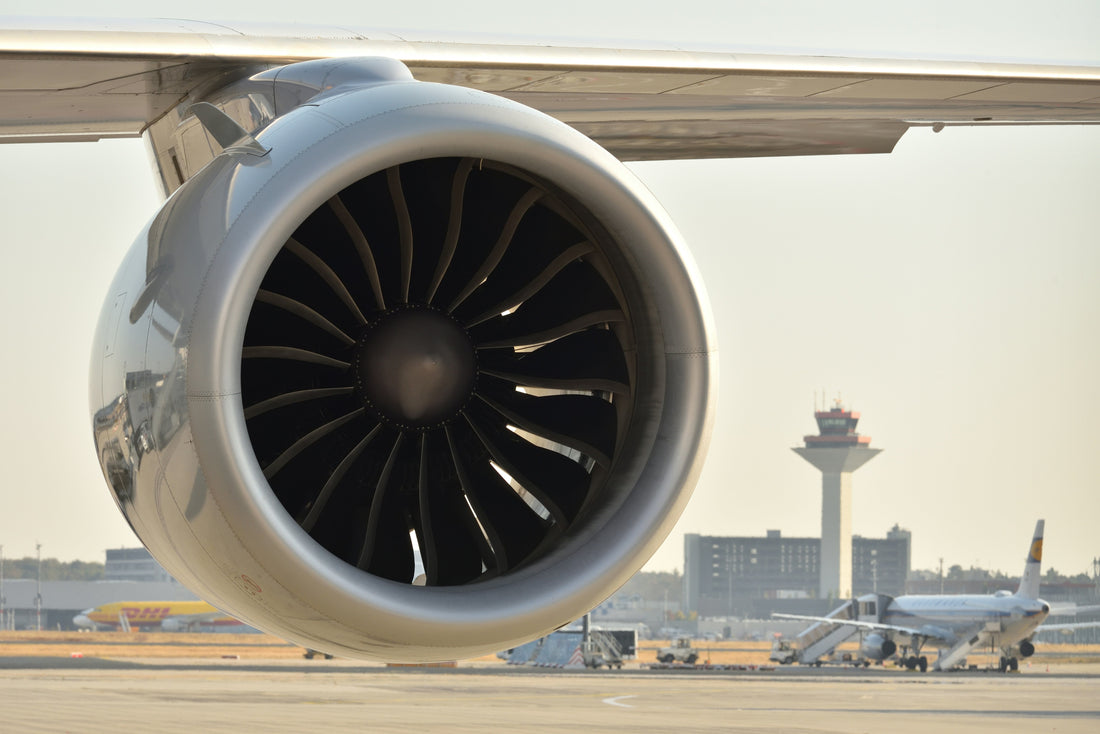
The different types of aircraft engines: piston, turboprop, jet
Partager
The engine is the heart of an airplane. It provides the power needed for takeoff, flight, and sometimes impressive speeds. But not all airplanes have the same type of engine: some still use piston engines, others operate with turbines, and the fastest fly thanks to jet engines. Let's discover these different systems together, simply explained.
Why are there different types of aircraft engines?
Aviation has evolved very quickly since the beginning of the 20th century. Each type of aircraft has specific needs: a small aeroclub aircraft does not have the same constraints as an airliner or a military fighter jet.
Power, fuel consumption, reliability, and speed are all criteria that explain why there are different engines adapted to each use.
Piston engines
The piston engine is the oldest and is still widely used today, especially in small training and touring aircraft.
Its principle is simple: it works like a car engine. Pistons compress a mixture of air and fuel which, when it explodes, generates force. This energy is transmitted to a propeller that propels the aircraft.
-
Advantages: low maintenance cost, simplicity, ideal for small aircraft.
-
Disadvantages: limited power, reduced flight speed, high consumption at high altitude.
👉 Example: the Cessna 172, one of the most popular aircraft in the world, uses a piston engine.
Turbine engines (turboprops)
The turbine is an intermediate step between the piston engine and the jet engine. It works thanks to a compressor that sucks in and compresses air, then a combustion chamber that releases enormous energy. This energy rotates a turbine connected to a propeller.
This system combines the power of a turbine with the efficiency of a propeller. It is perfect for regional and military flights requiring moderate speeds but high reliability.
-
Advantages: more powerful than a piston, efficient over medium distances, reliable.
-
Disadvantages: more expensive and more complex to maintain.
👉 Examples: the ATR 72 (regional aircraft) or the C-130 Hercules (military aircraft).
Jet engines
This is the iconic engine of modern airliners and military jets. Its operation is based on a simple principle: expelling air very quickly backwards to push the aircraft forwards.
There are several variants:
-
Pure turbojets, used in fighter jets.
-
Turbofans (or bypass jet engines), the most common on airliners, as they are quieter and more economical.
-
Afterburner, for supersonic military aircraft.
-
Advantages: enormous power, high speeds, suitable for long-haul flights.
-
Disadvantages: high consumption, very high cost.
👉 Example: the Boeing 777 uses GE90 turbofans, among the most powerful engines in the world.
Comparison of different aircraft engines
-
Consumption: piston engines consume a lot but for short distances, turbines are balanced, and jet engines are the most fuel-hungry.
-
Speed: piston (slow), turbine (medium), jet (very fast).
-
Usage: piston for small aircraft, turbine for regional flights, jet for airliners and military aircraft.
In summary: each engine has its area of excellence.
Conclusion: each engine for a specific need
From small touring aircraft to giant airliners, each aircraft engine has been designed to meet a specific objective. Piston engines enable millions of student pilots to fly, turbines power regional and military aviation, while jet engines allow the most modern aircraft to travel the globe at high speeds.
Watch a video on the different types of aircraft engines:
FAQ: We answer all your questions
What is the most powerful aircraft engine?
Some turbofans like the GE90 or the Rolls-Royce Trent XWB can develop over 50 tons of thrust, enough to propel a Boeing 777 or an Airbus A350.
What is the difference between a turboprop and a turbojet?
A turboprop uses a turbine to drive a propeller, while a turbojet uses only the expelled air jet to propel the aircraft.
Why are piston engines still used in aviation?
Because they are simple, reliable, and economical for small training and recreational aircraft.
What engine do modern airliners use?
Most use turbofans, which combine power, efficiency, and relative fuel economy.
Does an aircraft engine work like a car?
Only the piston engine resembles a car engine. Turbines and jet engines are based on very different principles.
How does an airplane wing work? (Simple and clear explanation)
2 comments
Vraiment ce cool
Vraiment ce cool