
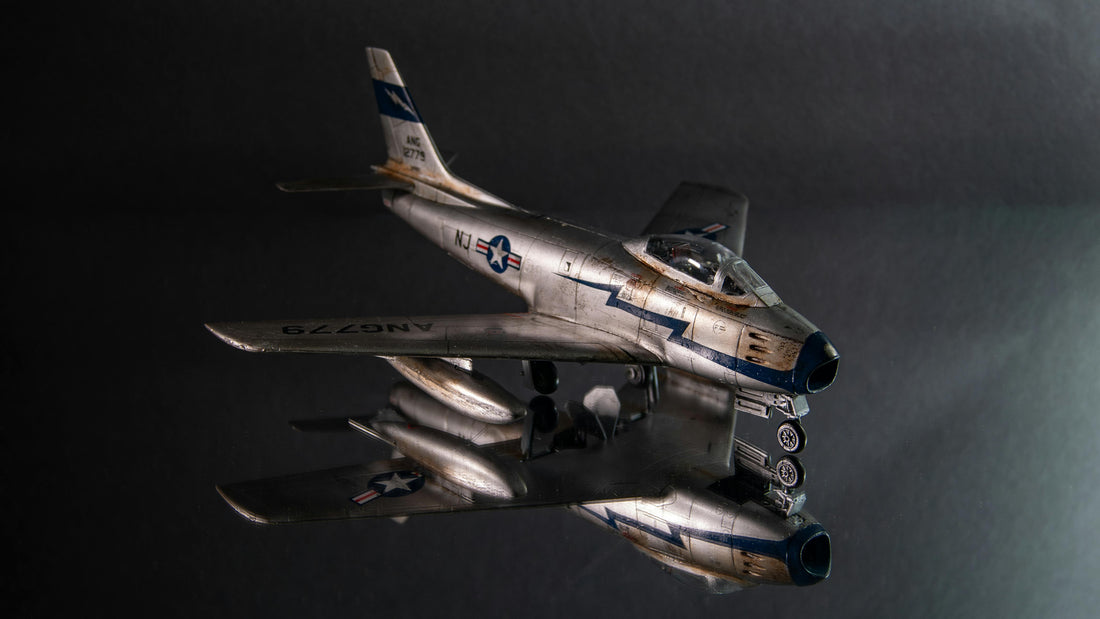
What scale should I choose for an airplane model?
Partager
You’ve found your dream model airplane, but one detail is holding you back: the scale. 1/144, 1/72, 1/48… These numbers may seem abstract at first glance, but they have a direct impact on the size of your model, the level of detail, and even the space it will take up in your home.
Whether you’re a passionate modeler or a curious beginner, choosing the right scale for your model is essential for a satisfying result. So, how do you navigate all these options? That’s what we’ll explore together in this article!
1. Introduction
When starting out in modeling or looking to expand your collection, one question often arises: what scale should I choose for my airplane model? This choice may seem trivial, but it directly influences the size of the model, the level of detail, and even the ease of assembly.
Some scales are more popular than others, especially depending on the type of aircraft (military, commercial, collector’s item) and the space available for display. But how do you make the right choice? In this article, we will review the different scales available, their advantages, and the essential criteria to help you find the one that best suits your expectations.
2. What is a scale in aircraft modeling?
When we talk about scale in modeling, we refer to the reduction ratio between the model and the real aircraft. Specifically, a 1/72 scale means that every centimeter of the model corresponds to 72 centimeters on the full-size aircraft. The higher the second number, the smaller the model.
This system allows manufacturers to offer realistic models while adapting them to different constraints, such as storage space or the desired level of detail. This is why some scales are more common than others: they offer a good balance between realism, size, and accessibility. In the rest of the article, we will explore the most popular scales and their uses to help you make the right choice.
3. The most popular scales and their use
There are many scales in modeling, but some are more widespread than others depending on enthusiasts’ preferences and the type of aircraft represented. Here’s an overview of the most common formats and their specific features.
3.1. 1/144 Scale: Miniature and collection
This scale is ideal for those who lack space or wish to collect several models without cluttering their shelves. Models at this scale are often airliners or military aircraft in formation, allowing for the recreation of interesting aerial scenes despite their small size.
3.2. 1/72 Scale: A good compromise
The 1/72 scale is one of the most popular, especially for military aircraft. It offers a good balance between reasonable size and a satisfactory level of detail. It’s an excellent choice for modelers who want well-detailed models without requiring too much space.
3.3. 1/48 Scale: The right balance between size and detail
With the 1/48 scale, we enter a category that appeals to enthusiasts seeking more realism. The models are larger and allow for more detail, particularly in the cockpit or on the aircraft’s structure. This scale is highly valued by diorama and exhibition enthusiasts.
3.4. 1/32 and 1/24 Scale: For realism enthusiasts
These large scales are intended for the most demanding modelers in terms of precision. 1/32 and 1/24 scale models offer an impressive amount of detail and are ideal for showcasing iconic aircraft. However, they require more space and patience to assemble.
Each scale has its advantages, and the choice will depend on your desires, your budget, and the space you have available. Now, let’s see how to choose the most suitable for your project.
4. How to choose the right scale for your project?
Choosing the scale of an airplane model is not done by chance. Several criteria come into play and can influence your decision based on your preferences, experience, and available space. Here are the key elements to consider before you start.
Available space
Before buying a model, it’s important to think about where you will display or store it. A 1/144 scale model will take up little space, while a 1/32 scale aircraft will require a sufficiently large shelf or display case. If you are short on space, it is better to opt for smaller scales.
Desired level of detail
If you like to observe every rivet and every structural line on your model, opt for a larger scale like 1/48 or 1/32. These formats allow for the integration of more precise details, especially in the cockpit and landing gear. Conversely, smaller scales like 1/72 or 1/144 offer a good compromise between realism and bulk.
Aircraft type
Some scales are more suited to specific types of aircraft. For example, military fighters are often offered in 1/72 or 1/48, while airliners are more common in 1/144 to maintain reasonable dimensions. If you have a specific aircraft in mind, check the options available in different scales.
Budget
The larger a model, the more expensive it generally is. Indeed, large-scale models require more materials and often offer a higher level of finish. If you are a beginner or have a limited budget, 1/72 or 1/144 scales are excellent choices to start without spending too much.
By considering these criteria, you can choose a scale that matches your expectations and fully enjoy your passion for aircraft modeling.
5. Conclusion
Choosing the scale of an airplane model is an essential step for any modeling enthusiast. This choice influences not only the size of the model, but also the level of detail, the space needed to display it, and even the budget to plan for.
If you are looking for a compact and easy-to-store model, 1/144 and 1/72 scales are excellent options. For a good balance between size and realism, 1/48 is a popular choice among experienced modelers. Finally, if you want maximum detail and have space, large scales like 1/32 or 1/24 will offer you total immersion.
The important thing is to find the scale that matches your project and your expectations. So, what will your next model be? Feel free to share your preferences and experiences in the comments!
FAQ: We answer all your questions
What scale for an airplane model?
The ideal scale depends on available space, desired level of detail, and aircraft type. 1/72 and 1/48 scales are the most common, offering a good balance between size and realism.
What is the best scale for model aircraft?
There is no single "best" scale for everyone, as it depends on your preferences and needs. However, the most popular are 1/72 for a good compromise between size and detail, and 1/48 for more realism. For extreme detail enthusiasts, 1/32 is ideal, while 1/144 is suitable for compact collections.
How to choose a model scale?
To choose a model scale, you need to consider available space, desired level of detail, aircraft type, and budget. Small scales (1/144, 1/72) are suitable for compact collections, while large scales (1/48, 1/32) offer more realism but require more space and investment.
How to calculate a scale for a model?
To calculate the scale of a model, divide the real size of the aircraft by the scale factor. For example, for a 10-meter aircraft at 1/72, the model will measure 10 ÷ 72 = 0.139 m (13.9 cm). Conversely, to find the real size of a model, multiply the length of the model by the scale.
What is the best brand of airplane model?
There isn't one single "best" brand for everyone, as it depends on your preferences and needs. However, renowned brands like Tamiya, Hasegawa, Revell, and Airfix are widely appreciated for their quality, precision, and the diversity of their models. Tamiya, for example, is often cited for its exceptional detail and well-designed kits.
What is the size of a 1/200 airplane model?
The size of a 1/200 scale airplane model depends on the actual dimensions of the aircraft. For example, if an aircraft is 60 meters long in reality, at 1/200 scale, the model will measure 60 ÷ 200 = 0.30 m, or 30 cm. This significantly reduces the size of the model while maintaining realistic proportions.
What is the length of a 1:400 scale aircraft?
To calculate the length of a 1/400 scale aircraft, simply divide the actual length of the aircraft by 400. For example, if an aircraft is 70 meters long in reality, at 1/400 scale, the model will measure 70 ÷ 400 = 0.175 m, or 17.5 cm.