
The Story of the Wright Flyer: The First Powered Aircraft in History
Partager
Today, air travel seems commonplace. But not so long ago, flying was still a dream. This dream was realized by two American brothers, Wilbur and Orville Wright, with an aircraft that has become legendary: the Wright Flyer. It was with this rustic but revolutionary aircraft that they accomplished the first controlled, powered flight in history, in December 1903. Here is the story of this invention that literally launched humanity into the sky.
Historical Context: The Dawn of Aviation
Dreams of Conquering the Sky
Humans have always dreamed of flying. From Greek mythology to Leonardo da Vinci, and including the first hot air balloons, the idea of taking to the skies has been fascinating. But until then, no heavier-than-air machine had managed to fly in a controlled manner with an engine.
The Forgotten Precursors
Before the Wright brothers, several inventors attempted the feat. The German Otto Lilienthal, for example, made hundreds of glides before dying in a crash. The Frenchman Clément Ader, for his part, designed the Éole, an aircraft that reportedly briefly left the ground, but without controlling its flight. These pioneers laid the groundwork, but something was still missing: the mastery of powered flight.
The Wright Brothers: Two Visionary Pioneers
Wilbur and Orville Wright, a Childhood Passion
Originally from Ohio, the Wright brothers grew up surrounded by books and machines. Sons of a pastor, they did not pursue higher education, but their curious minds led them to dismantle and rebuild everything they could get their hands on. In their teenage years, they set up their own bicycle repair shop, an area that allowed them to acquire a solid foundation in mechanics and aerodynamics.
A Rigorous Scientific Method
Rather than rushing in headfirst, Wilbur and Orville spent a long time observing birds in flight. They experimented with gliders, built a homemade wind tunnel, and tested different wing shapes. Their approach was methodical, almost scientific. Unlike other inventors of the time, they quickly understood that controlling the aircraft in flight was as important as its propulsion.
The Birth of the Wright Flyer
A Homemade, Yet Innovative Aircraft
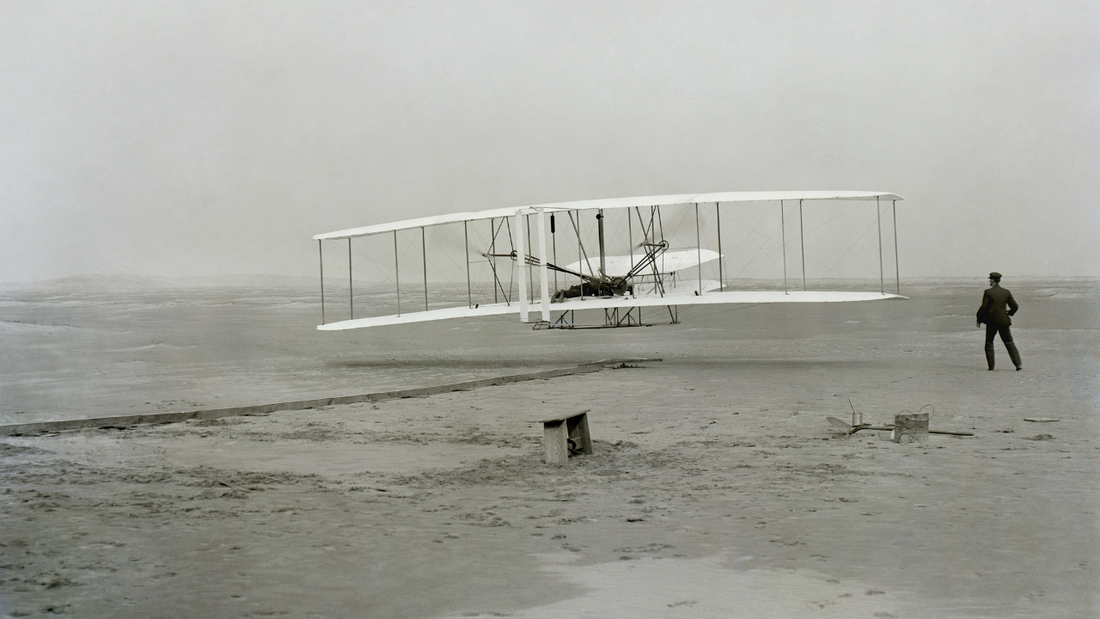
The Wright Flyer, built in 1903, was an aircraft that was both simple and audacious. Its structure was made of pine wood and cotton fabric. It was equipped with a 12-horsepower gasoline engine, designed with the help of their mechanic Charlie Taylor. The two propellers, placed at the rear, were driven by bicycle chains. The aircraft weighed approximately 275 kg (600 lbs).
Ideas Ahead of Their Time
The major innovation lay in the control system. The Wright brothers developed a mechanism that allowed them to control the aircraft on three axes: pitch (up/down), roll (lateral tilt), and yaw (direction). To pilot, the aviator lay on the lower wing and maneuvered with levers and a harness. This system already foreshadowed that of modern aircraft.
The Historic Flight of December 17, 1903
Kitty Hawk, a Windy Place
It was in the windy dunes of Kitty Hawk, North Carolina, that the Wright brothers chose to test their machine. On December 17, 1903, on a cold morning, they conducted a series of trials.
12 Seconds That Changed History
At 10:35 AM, Orville Wright took his place aboard the Wright Flyer. The aircraft took off on a launching rail and… lifted off! It flew for 12 seconds over 36 meters (120 feet) at an average speed of 11 km/h (6.8 mph). A few moments later, Wilbur also made a flight of 59 seconds over 260 meters (852 feet).
These performances may seem negligible today, but at the time, it was a revolution. For the first time, a powered, heavier-than-air machine flew in a controlled manner.
The Legacy of the Wright Flyer in Aviation History
A Decisive Breakthrough
The flight of the Wright Flyer marked the beginning of a new era. Within a few years, aviation made spectacular leaps forward. As early as 1908, the Wright brothers gave demonstrations in Europe and the United States, attracting the attention of military personnel and engineers.
A Lasting Influence
Their method, based on observation, experimentation, and rigor, became a model for future generations of aviators. The concept of three-axis control remains a cornerstone of aeronautical piloting today.
An Aircraft Visible Today
The original Wright Flyer is on display at the National Air and Space Museum in Washington, D.C. Faithful replicas also exist in several museums around the world, such as the Musée de l'Air et de l'Espace at Le Bourget in France.
Discover the Wright Flyer model
Anecdotes and Little-Known Facts
A Long-Ignored Flight
For years, the flight of the Wright Flyer was underestimated, particularly in Europe where some disputed its authenticity. But photos, newspapers, and testimonies eventually established the truth.
The Forgotten Mechanic's Role
Few people know Charlie Taylor, the Wrights' mechanic, who built their engine in a few weeks. Without him, the plane would never have taken off.
A Piece of the Flyer on the Moon
During the Apollo 11 mission in 1969, a fragment of the Wright Flyer's fabric was taken to the Moon by Neil Armstrong, himself a pilot before becoming an astronaut. A magnificent tribute to the genius of the Wright brothers.
Conclusion: A Small Flight for Man, a Giant Leap for Mankind
The Wright Flyer only flew for a few dozen meters. But this brief and bumpy flight was enough to show that man could master the air. It paved the way for modern aviation, intercontinental travel, fighter jets, drones… and even space exploration. A beautiful lesson in daring, perseverance, and ingenuity.
Watch a video about the Wright Flyer:
FAQ: We Answer All Your Questions
What is the true name of the Wright brothers' first aircraft?
It was officially called the Wright Flyer, but it is sometimes nicknamed "Flyer I" or "Flyer 1903."
How many flights did it make?
On December 17, 1903, four successful flights were made. After that, the aircraft was damaged by a gust of wind.
What was its speed?
Approximately 10 to 15 km/h (6 to 9 mph), depending on the tests. It was not the speed that mattered, but stability and control.
Why is this flight considered historic?
Because it was the first sustained, controlled, powered flight of a heavier-than-air aircraft.