
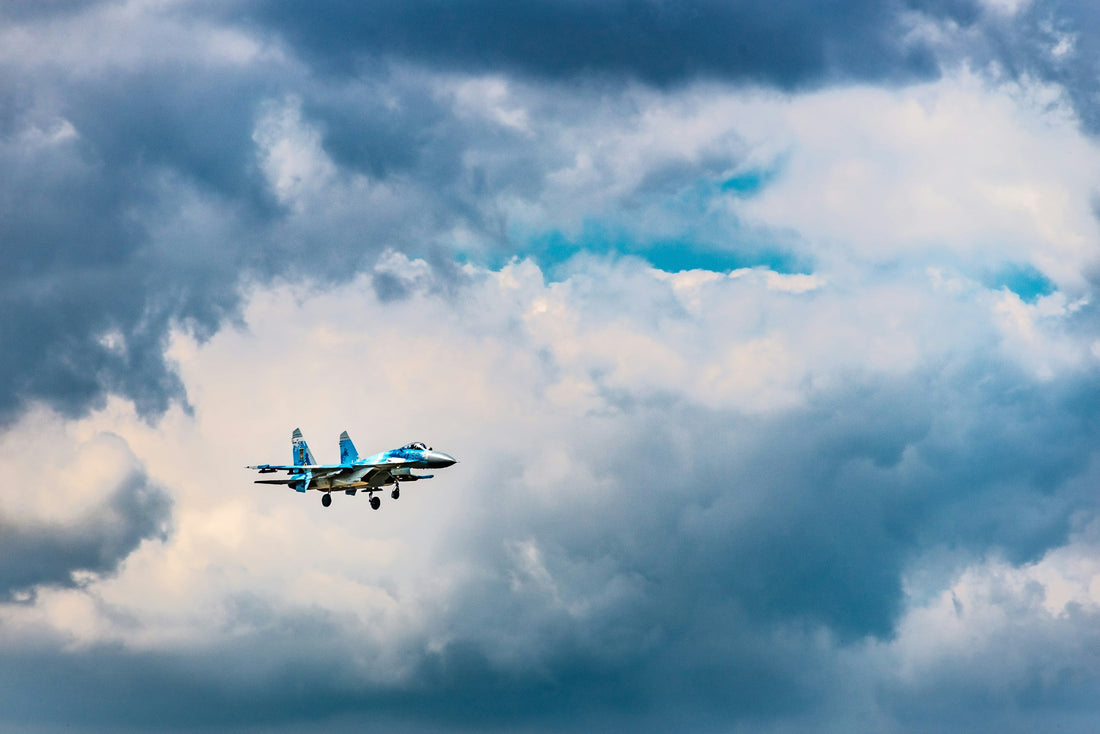
The Sukhoi Su-27 Story: The Soviet Fighter That Challenged the West
Partager
When we talk about the iconic Cold War fighters, the Sukhoi Su-27 is undoubtedly one of the most impressive. This giant of the skies, both elegant and formidable, alone symbolizes the Soviet Union's determination to compete with the best Western fighter jets. Behind its powerful lines lies a fascinating technical, political, and military history, which we invite you to discover here.
Historical Context: The USSR Facing Western Air Superiority
In the 1970s, the global military landscape was undergoing profound changes. The United States had just introduced revolutionary aircraft like the F-15 Eagle and the F-16 Fighting Falcon, capable of dominating the skies with previously unmatched technological superiority. Faced with this new generation of American fighters, the USSR found itself under pressure: it absolutely had to react.
The Kremlin then launched an ambitious program called PFI (Perspektivnyi Frontovoy Istrebitel), aiming to design a new air superiority fighter capable of countering the rise of Western aircraft. It was in this tense context, where rivalry between blocs was also played out in the air, that the future Su-27 was born.
The Birth of the Su-27: Design and Development
The development of the Su-27 was entrusted to the Sukhoi Design Bureau, already well-known for its robust and high-performing aircraft. The beginnings were not simple, however. The first prototypes, designated under the code name T-10, revealed numerous problems: aerodynamic instabilities, disappointing performance, and piloting difficulties.
But Soviet engineers did not give up. Thanks to a complete redesign of the airframe, optimization of flight controls, and more advanced aerodynamics, they gave birth to a much more powerful version: the T-10S, which would become the Su-27 as we know it today.
The fighter officially entered service with the Soviet Air Force in the mid-1980s, with the primary mission of intercepting and neutralizing any enemy aircraft approaching Soviet airspace.
Technical Performance and Innovations of the Su-27
What is immediately striking about the Su-27 is its appearance: a long, slender silhouette, large curved wings, and an iconic twin vertical stabilizer. But its beauty also conceals formidable efficiency.
The Su-27 is powered by two Saturn AL-31F engines, allowing it to reach supersonic speeds exceeding Mach 2. It is capable of flying at high altitude while maintaining excellent maneuverability at low speed – a rare asset for an aircraft of its size.
The aircraft is also equipped with a powerful radar and a comprehensive arsenal: medium and short-range air-to-air missiles, a 30 mm cannon, and an electronic suite capable of detecting and tracking multiple targets simultaneously.
Compared to the American F-15, its main rival, the Su-27 stands out for its exceptional agility, particularly thanks to its fly-by-wire controls and advanced aerodynamic design.
The Su-27 Variants: A Constantly Evolving Family
The success of the Su-27 did not stop at its original version. Quickly, several variants emerged, each adapted to specific missions or foreign requirements.
Among the best known:
-
Su-27UB: two-seat version for advanced training
-
Su-30: multirole fighter derived from the Su-27, widely exported
-
Su-33: navalized version used on Russian aircraft carriers
-
Su-35: ultra-modern evolution with thrust vectoring engines and advanced electronics
The Su-27 was also exported to China, where it served as the basis for the development of the Shenyang J-11, and to India, with cooperation that led to the Su-30MKI, a hybrid model with local specificities.
The Su-27 in Operations: A Legend of Military Aviation
Although it was not involved in major conflicts during the Cold War, the Su-27 often shone during military exercises and air shows. Its ability to perform spectacular maneuvers – like the famous "Pugachev's Cobra" – largely contributed to forging its reputation.
Over the decades, it has continued to fly under various roundels: Russia, Ukraine, Angola, Ethiopia, Kazakhstan, etc. Everywhere, it has managed to establish itself as a feared adversary, even against the most recent aircraft.
Legacy and Impact of the Su-27 in Modern Aviation
The Su-27 is not just a high-performance fighter jet. It also marked a key step in the evolution of Soviet and then Russian military doctrine. Its design and performance inspired a new generation of fighters, including the Su-35, and more broadly influenced the design of fifth-generation aircraft like the Su-57.
Even today, it is considered a symbol of air power. Its long journey testifies to the ingenuity of the Sukhoi bureau, capable of competing with the world's largest aircraft manufacturers.
Discover the Su-27 model
Did you know? Anecdotes about the Su-27
-
The Su-27 is capable of performing the famous "Cobra", an extreme maneuver that involves abruptly pitching the aircraft's nose up to 120° before returning to horizontal, without losing control.
-
In 1989, an Su-27 dazzled spectators at the Paris Air Show with a breathtaking demonstration, making a lasting impression with its grace and power.
-
It was the first Soviet aircraft to be designed from the outset to confront American air superiority aircraft on equal terms – and even surpass them in some areas.
Conclusion
The Sukhoi Su-27 is much more than a fighter jet: it is a symbol of technological resilience and air supremacy, born in the heart of an ideological war between two superpowers. Even today, it continues to fascinate aviation enthusiasts with its power, elegance, and enduring legacy. A giant of the skies that history will not soon forget.
Watch a video about the history of the Sukhoi Su-27:
FAQ: All Your Questions Answered
When did the Sukhoi Su-27 enter service?
The Su-27 officially joined the Soviet Air Force in 1985, after several years of intensive development and testing.
What is the difference between the Su-27 and the Su-30?
The Su-30 is a modernized and multirole version of the Su-27, with a two-seat capability and improved avionics, intended for more varied missions.
Which aircraft rivaled the Su-27 in the West?
The main competitor of the Su-27 was the American F-15 Eagle, although it was also compared to the F-16 or even the Mirage 2000 in certain contexts.
Is the Su-27 still in use today?
Yes, several countries still use the Su-27, notably Russia, Ukraine, and several former Soviet republics, although many models have been modernized.
The History of the Sukhoi Su-35: An Exceptional Russian Fighter