
The History of the Northrop B-2 Spirit
Partager
In the sky, some aircraft leave no trace. The Northrop B-2 Spirit is one of them. With its futuristic silhouette and its ability to evade radar, this stealth bomber has become a symbol of technological power. But behind its mysterious appearance lies a fascinating history, combining military secrets, scientific advances, and geopolitical stakes.
Since its appearance in the 1980s, the B-2 Spirit has continuously been the subject of discussion. A strategic aircraft of the US Air Force, it has participated in several major conflicts, while remaining one of the most expensive and secretive aircraft ever designed. In this article, we invite you to dive into the complete history of this discreet giant of the sky.
Genesis of a Secret Project
The Geopolitical Context of the 1970s-1980s
In the late 1970s, the world was in the midst of the Cold War. The United States sought to maintain its aerial superiority in the face of an increasingly threatening Soviet Union. In this tense climate, the need for a bomber capable of striking deep while evading enemy defenses became a priority.
The Pentagon then launched an ambitious project: to design a new strategic bomber aircraft, undetectable by radar. This ultra-secret program would be named the Advanced Technology Bomber.
The Birth of the Northrop B-2
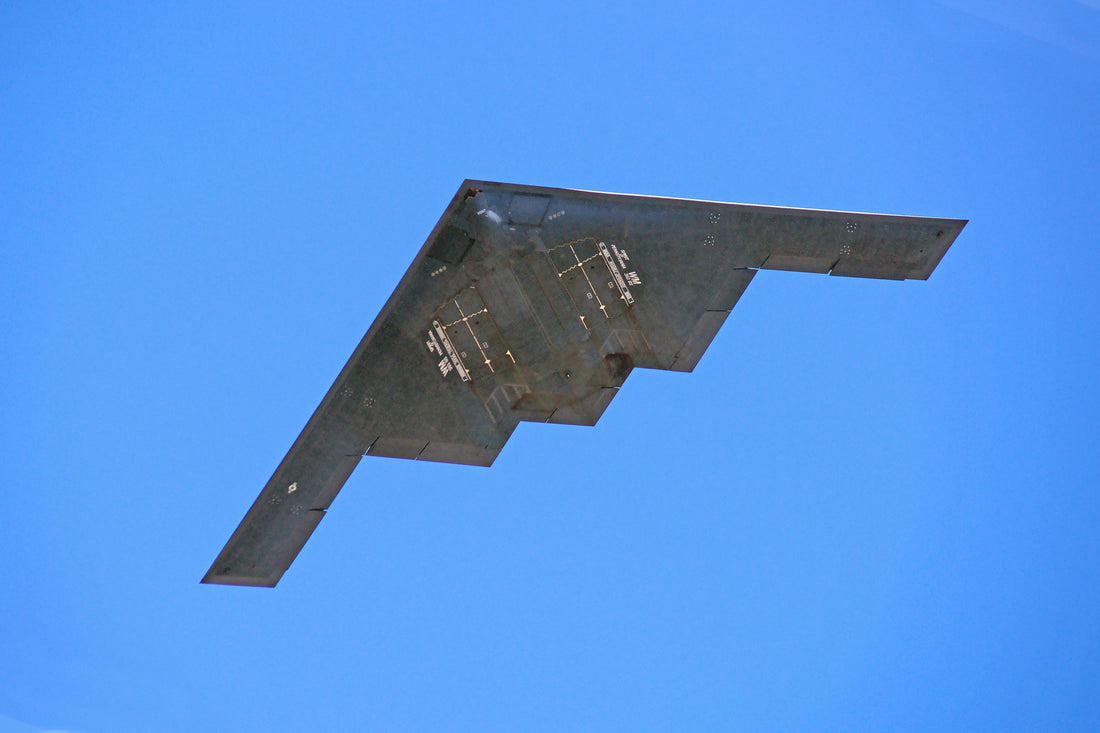
The project was entrusted to Northrop Corporation, in partnership with Boeing. Engineers worked in utmost secrecy, developing a completely novel aircraft. The result: a flying wing aircraft, without tail or vertical surfaces, designed to minimize its radar signature.
The B-2 was first presented to the public in 1988, but its official entry into service would not occur until 1997. Throughout these years, it remained a mystery to the general public... and an enigma for foreign powers.
State-of-the-Art Stealth Technology
A Unique Shape to Evade Radar
What is striking first about the B-2 Spirit is its design. Unlike conventional aircraft, it has no visible tail or fuselage. Its flying wing shape significantly reduces radar echoes. Every detail is designed to limit wave reflection: air intakes are concealed, edges are smooth, and the paint itself absorbs radar signals.
Ultra-Sophisticated Onboard Systems
The B-2 is also equipped with very high-tech avionics. Its sensors, navigation systems, and communications are all optimized to operate in hostile environments without being detected. It is capable of flying at high altitudes for tens of hours, with great autonomy thanks to in-flight refueling.
An Aircraft Built for Critical Missions
Entry into Service and First Missions
The B-2 Spirit officially entered service with the US Air Force in 1997. It is based at Whiteman Air Force Base, Missouri, where its rare, hand-picked crews are trained. Each aircraft is given a symbolic name, often related to an American state.
Its first operational missions took place in 1999, during the Kosovo War. It was then deployed in Afghanistan and Iraq, where it struck strategic targets with surgical precision. Its effectiveness relies on a unique blend of stealth, endurance, and strike capability.
A Major Deterrent Role
The B-2 Spirit is not just a conventional bomber. It is also part of the American nuclear triad. Capable of carrying nuclear or conventional bombs, it plays a key role in the United States' strategic deterrence.
An Exorbitant Cost
The Price of a Stealth Aircraft
Developing and building such an advanced aircraft comes at a price. And not a small one. The unit cost of a B-2 is estimated at over 2 billion dollars. In addition, there are very high maintenance costs, particularly to preserve the special paint that ensures its stealth.
Fewer Aircraft Than Planned
Originally, the US military planned to order 132 units. But budgetary constraints and the end of the Cold War reduced this number to only 21 units produced, 20 of which are still in service today. Only one aircraft, the Spirit of Kansas, was lost in a takeoff accident in 2008.
A Technological and Strategic Legacy
An Aircraft That Made Military History
The B-2 Spirit redefined the rules of aerial warfare. It showed that an aircraft could penetrate the most sophisticated defenses, strike with precision, and then disappear. Its design and technology have influenced many military projects around the world.
The Future: Heading for the B-21 Raider
The B-2's story is slowly coming to an end. It is gradually being replaced by the B-21 Raider, a new stealth aircraft developed by Northrop Grumman. More modern, more economical, and even stealthier, it is expected to enter service in the coming years. But the B-2 will remain an icon of military aviation.
Discover our B-2 Spirit model
Conclusion
The Northrop B-2 Spirit is much more than an aircraft: it is a flying legend. Its audacious design, combat effectiveness, and strategic role make it a symbol of American technological superiority. Even after several decades of service, it continues to impress with its silence, discretion, and power.
Its legacy is immense, and its successor, the B-21 Raider, will have a hard time matching this monument of aeronautical history.
Watch a documentary about the history of the Northrop B-2 Spirit:
FAQ: We Answer All Your Questions
What Makes the Northrop B-2 Spirit Stealthy?
Its flying wing design, the use of radar-absorbent materials, and the integration of technologies that reduce its thermal and electromagnetic signature.
How many B-2 Spirits are still in service?
Of the 21 aircraft produced, 20 are still in active service with the US Air Force.
Can the B-2 carry nuclear weapons?
Yes, it is part of the US nuclear triad and can carry nuclear or conventional bombs.
What is the difference between the B-2 and the B-21 Raider?
The B-21 is a more modern version, with better stealth, reduced costs, and scalable capabilities to adapt to future conflicts.