
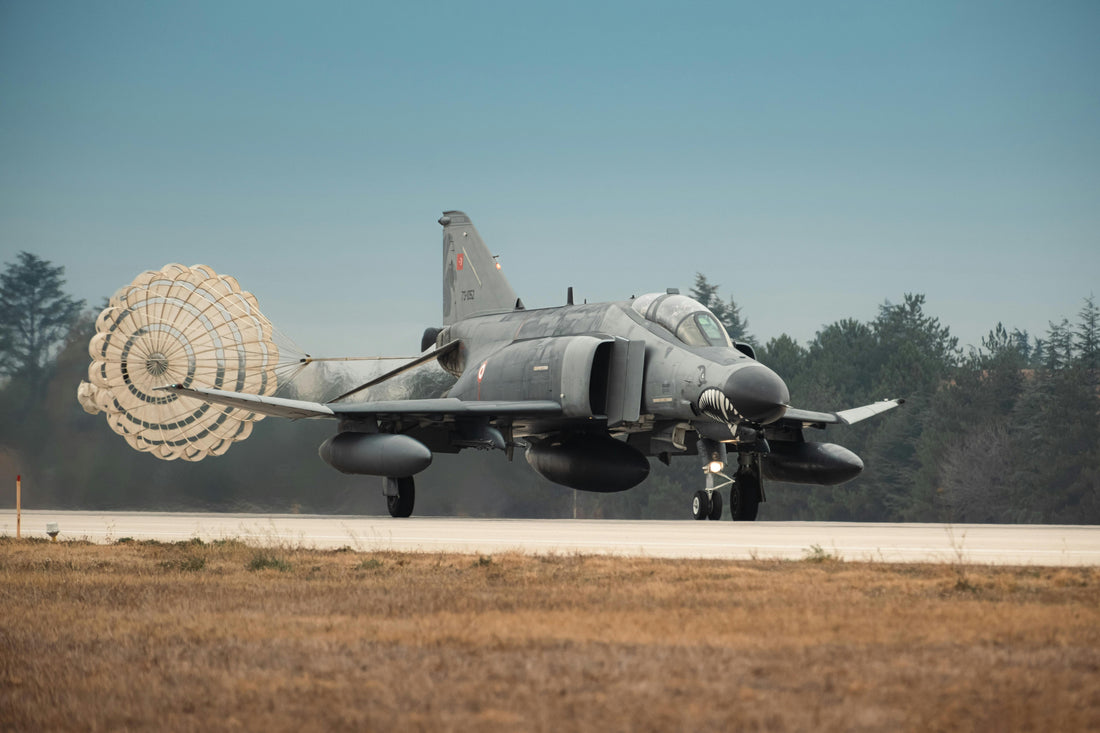
The History of the F-4 Phantom: The Legendary Fighter That Defined Military Aviation
Partager
For over 60 years, the F-4 Phantom has soared through the skies worldwide, becoming one of the most iconic fighter jets in military history. Born in the heart of the Cold War, this aircraft with its instantly recognizable silhouette has left its mark on generations of pilots and aviation enthusiasts.
Designed to meet specific strategic needs, the Phantom was more than just a combat aircraft: it symbolized an era, conflicts, technological advancements, and a certain vision of air power. Here is its story.
The origins of the F-4 Phantom
A strategic need in a tense world
In the late 1950s, tensions between the United States and the Soviet Union were at their peak. In this context, the US Navy was looking for a new aircraft capable of performing air superiority, ground attack, and interception missions. The specifications were ambitious: it needed a fast, powerful, reliable aircraft capable of carrying significant armament.
McDonnell Douglas enters the scene
McDonnell Aircraft Corporation (later to become McDonnell Douglas) was entrusted with the project. The prototype, initially designated F4H-1, quickly took shape and made its first flight on May 27, 1958. From its beginnings, the Phantom impressed with its performance, particularly its top speed which exceeded Mach 2.
Technical characteristics of the F-4 Phantom
A formidable supersonic two-seater aircraft
The F-4 Phantom is a twin-engine, two-seater aircraft, capable of flying at over 2,370 km/h. It can reach an altitude of over 18,000 meters and carry nearly 8 tons of payload. Its power, combined with great versatility, made it a unique aircraft of its kind at the time.
Impressive armament
Initially, the Phantom was not equipped with an integrated cannon — a controversial choice, but consistent with the "all-missile" doctrine of the time. It carried AIM-7 Sparrow and AIM-9 Sidewinder air-to-air missiles, as well as bombs for ground attack missions. Later, some versions were fitted with a 20mm M61 Vulcan cannon. Its AN/APQ-120 radar allowed long-range target detection and lock-on, even in bad weather.
An extraordinary international career
The F-4 in American ranks
From the 1960s, the Phantom was adopted not only by the Navy, but also by the US Air Force and the Marines. It thus became the only aircraft simultaneously used by the three main branches of the American military. Its role during the Vietnam War was central: it escorted bombers, conducted ground attacks, and confronted North Vietnamese MiGs in intense aerial dogfights.
An export success
The F-4 didn't stop there. It was exported to many countries: Germany, the United Kingdom, Japan, Israel, Greece, Turkey... Each country adapted the aircraft to its own needs. Some models were even modernized locally to extend their operational lifespan. In Israel, for example, the Phantom was nicknamed "Kurnass" ("Hammer") and played a crucial role in several conflicts.
The arrival of the new generation
The passing of the torch
From the 1980s, a new generation of more modern aircraft gradually began to replace the Phantom: F-15 Eagle, F-16 Fighting Falcon, F/A-18 Hornet, etc. More agile, equipped with more advanced on-board electronics, these aircraft offered superior performance in most areas.
But the Phantom resists
Despite this, the F-4 continued to fly in several countries, sometimes until the 2010s. Some aircraft were even converted into target drones (QF-4) for the training of US armed forces. Its robustness and ease of maintenance extended its career far beyond initial forecasts.
A living legacy
A legend in museums... and hearts
Today, the Phantom is exhibited in numerous aviation museums around the world. It still fascinates enthusiasts, and several aircraft are kept in flying condition by private associations. Its massive silhouette, its condensation trails, its characteristic roar... everything about it evokes a bygone but unforgettable era.
A lasting influence
The F-4 Phantom has influenced the design of many modern aircraft. It has provided valuable lessons on combat systems, cockpit ergonomics, maneuverability, and sensor integration. Its legacy is as much technical as it is human.
Discover the F-4 Phantom model
Anecdotes and little-known facts
-
The Phantom set 15 world records in the 1960s, including those for speed and altitude.
-
It was often nicknamed "the flying brick", in reference to its not-so-aerodynamic silhouette... but it knew how to hold its own against its adversaries.
-
Japan was one of the last countries to use the Phantom until 2020, more than 60 years after its first flight.
Conclusion
The F-4 Phantom is not just a fighter jet: it is a legend of military aviation. It served for decades in the skies around the world, enduring conflicts, eras, and doctrines. It has left behind a rich legacy, pilot stories, records, and a place of its own in aviation history.
And you, have you ever seen or heard an F-4 Phantom fly? Feel free to share your memories or impressions in the comments.
Watch a video about the history of the F-4 Phantom:
FAQ: We answer all your questions
What is the top speed of the F-4 Phantom?
It can reach approximately 2,370 km/h, or over Mach 2.
How many units were built?
Approximately 5,195 aircraft were produced between 1958 and 1981.
Which countries still use the F-4 Phantom?
Turkey, Greece, and Iran still use it to some extent, with modernized versions.
Why is the F-4 Phantom so famous?
For its longevity, its performance, its participation in numerous conflicts, and its key role in the Cold War.