
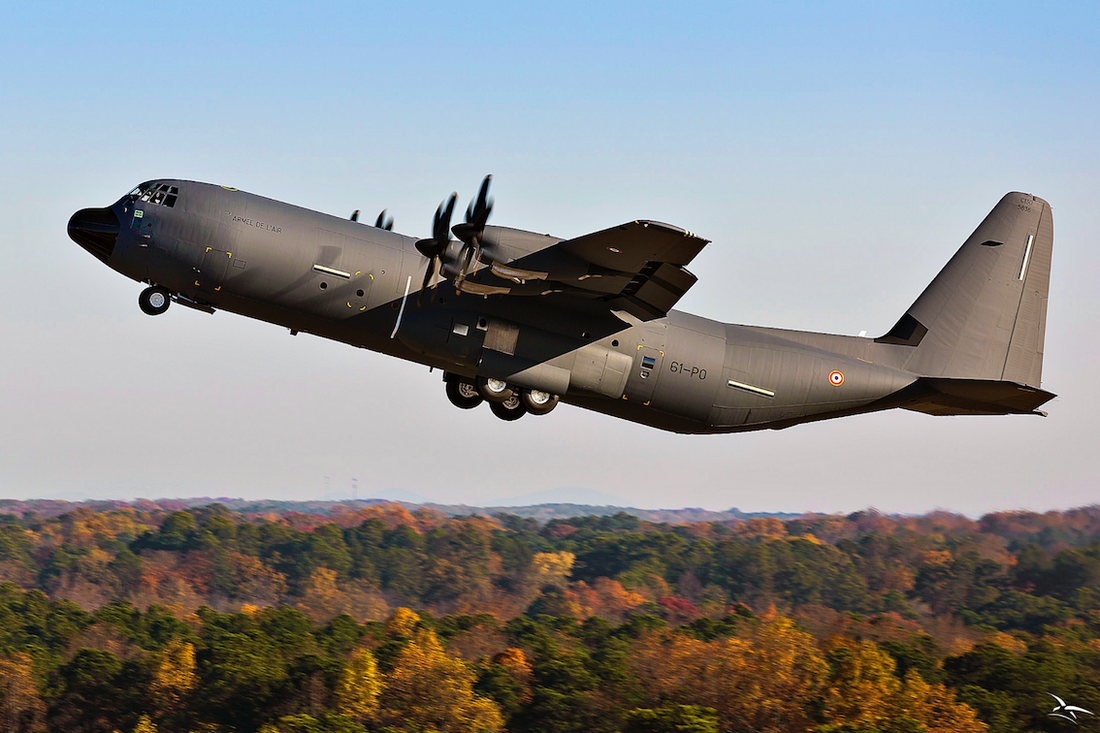
The History of the C-130 Hercules
Partager
The Lockheed C-130 Hercules is a military transport aircraft that is among the most iconic and versatile ever built. Since its design in the 1950s, it has served as a pillar for the armed forces of many countries, becoming a symbol of reliability, robustness, and adaptability.
A sky giant spanning decades
Among the most iconic military aircraft in aviation history, the C-130 Hercules holds a special place. Versatile, robust, and still operational more than 70 years after its first flight, this tactical transport aircraft designed by Lockheed Martin has become a true aerial legend. Whether in times of war or during humanitarian missions, the Hercules has always delivered.
But where did it come from? Why has it been so successful? And how has it managed to adapt over the decades? Let's dive into the fascinating history of the C-130 Hercules.
The origins of an aircraft like no other
In the early 1950s, the US Air Force was looking for a new transport aircraft capable of taking off and landing on short, often rudimentary runways, while carrying heavy loads. The context was tense: the Cold War was setting in, regional conflicts were multiplying, and the American army needed an aircraft capable of intervening anywhere in the world.
It was Lockheed (which would later become Lockheed Martin) that won the contract. Their project: a four-engine propeller aircraft, capable of operating in extreme conditions. The design of the future Hercules was born then, conceived from the outset to be simple, solid, and easily modifiable according to needs.
A first flight in 1954 and promising beginnings
The first flight of the C-130 took place on August 23, 1954. Rapidly, the aircraft impressed: its short takeoff performance, its carrying capacity, and especially its reliability seduced pilots and staff.
The first version, the C-130A, entered service in the late 50s. It was quickly followed by improved variants such as the C-130B and then the C-130E, with greater autonomy. With each evolution, the aircraft gained in power, payload, and adaptability.
Constant evolution to stay in the race
Unlike many military aircraft replaced after one or two decades, the Hercules continues to evolve. In the 1970s, the C-130H version brought new engines and modernized avionics. Then, in the 1990s, the C-130J Super Hercules arrived.
This latest version represents a technological leap: Rolls-Royce AE 2100D3 engines, six-blade propellers, an entirely digital cockpit, and increased payload. All while retaining the basic qualities of the original aircraft.
Thanks to these successive modernizations, the C-130 remains perfectly adapted to current missions, while reducing maintenance costs.
Missions as diverse as they are impressive
What makes the C-130 Hercules strong is its versatility. It was designed for military transport, but it quickly showed that it could do much more.
It has participated in troop parachutes, the evacuation of wounded, the transport of heavy equipment, and even in-flight refueling. Some models have even been transformed into bombers (C-130 Gunship), reconnaissance aircraft, or electronic warfare platforms.
But the Hercules is not limited to war missions. It has also been a major player in humanitarian operations: resupply after natural disasters, dropping food in disaster areas, or fighting forest fires with the MAFFS (Modular Airborne Fire Fighting System) version.
Discover our C-130 Hercules model
An aircraft adopted worldwide
While the C-130 is primarily an American aircraft, it has been adopted by more than 70 countries around the world. From Australia to the United Kingdom, from India to Brazil, including France and Canada, it has served in a wide variety of contexts.
Its reliability and its ability to operate on unprepared runways make it a valuable ally, especially for countries with limited infrastructure. Result: more than 2,500 units have been produced, and some are still active after 40 or 50 years of service.
An aviation icon in popular culture
The C-130 Hercules is so famous that it has gone beyond the strictly military sphere. It can be found in many war films, such as Black Hawk Down, Transformers or 12 Strong. It also appears in television series and video games, reinforcing its image as a robust and reliable aircraft.
Its instantly recognizable silhouette, with its stout fuselage and four noisy engines, makes it a true aviation icon.
What does the future hold for the Hercules?
Even after all these years, the Hercules shows no signs of imminent retirement. The C-130J Super Hercules version is still in production, and many countries continue to modernize their existing fleets.
Replacement projects exist, but no aircraft has yet fully managed to match the unique combination of versatility, robustness, and longevity offered by the C-130. It is therefore likely that this aircraft will continue to fly for several more decades.
Conclusion: a timeless titan of the skies
For over 70 years, the C-130 Hercules has embodied excellence in military aviation. Both simple and sophisticated, modular and reliable, it has adapted to the needs of a constantly evolving world. Its history is that of an aircraft that has endured, improved, and served in both obscurity and prominence, for war and for peace.
More than just an aircraft, the Hercules has become a symbol of aeronautical ingenuity and operational endurance.
Watch a video about the history of the C-130 Hercules:
FAQ: we answer all your questions
What is the main mission of the C-130 Hercules?
The C-130 Hercules was designed primarily for military tactical transport: delivering equipment, troops, or vehicles to difficult-to-access terrains. Over time, it has been adapted for other missions such as in-flight refueling, medical evacuations, parachuting, firefighting, and humanitarian missions.
How long has the C-130 been in service?
The C-130 Hercules has been in service since 1956, when the first operational version (C-130A) was delivered to the US Air Force. It is one of the oldest military aircraft still in active service worldwide.
How many C-130 units have been built?
Since its launch, more than 2,500 units of the C-130 have been produced, all versions combined. Its longevity and versatility explain its widespread deployment worldwide.
What is the difference between the C-130 and the C-130J Super Hercules?
The C-130J Super Hercules is a modernized version of the aircraft. It features an entirely digital avionics suite, more powerful engines, improved flight efficiency, and a cockpit designed to be operated by only two pilots, without a flight engineer.
Which countries still use the C-130 today?
The C-130 is used in more than 70 countries. Among them: the United States, the United Kingdom, Australia, France, Canada, India, Japan, Brazil, Egypt, and many others. Some still operate older versions, while others have opted for the C-130J version.
Is the C-130 Hercules still manufactured today?
Yes, the C-130J Super Hercules version is still in production by Lockheed Martin. It benefits from regular improvements and remains highly demanded by armed forces worldwide.
What is its reputation for reliability due to?
The C-130 is renowned for its mechanical robustness, its ability to operate on rudimentary runways, and its relatively simple maintenance. It was designed to last, and its modular design facilitates repairs and adaptations.
Top 5 Fighter Jets that Made History in Military Aviation
The History of the Boeing C-17 Globemaster III: A Military Giant of the Sky