
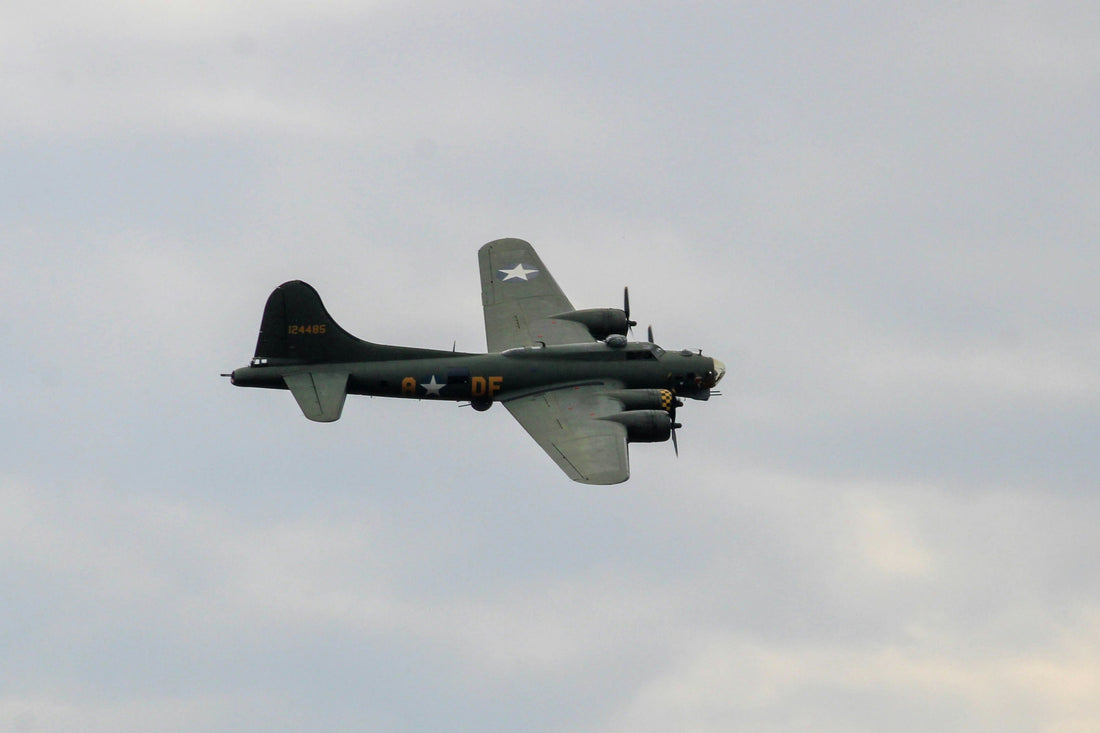
The Story of the Boeing B-17 Flying Fortress
Partager
Among the legendary aircraft of World War II, few have left as strong a mark as the Boeing B-17 Flying Fortress. This heavy bomber, with its robust design and imposing appearance, shaped the history of military aviation. It not only played a crucial strategic role during the conflict but also became a symbol of American air power. Let's look back at the fascinating history of this legendary aircraft.
The origins of the Boeing B-17 Flying Fortress
The historical context of the 1930s
In the early 1930s, the US Army sought to modernize its fleet. The idea was to develop a bomber capable of striking long-range targets while withstanding heavy attacks. The concept of strategic bombing began to take shape, and Boeing engineers saw an opportunity.
The development of the Model 299 project
This led to the creation of the Model 299 prototype, first presented in 1935. Equipped with four engines and an elongated fuselage, it immediately stood out for its promising performance. During its maiden flight, the aircraft impressed with its speed, maximum altitude, and ability to carry a heavy bomb load.
The origin of the nickname "Flying Fortress"
It was a journalist who, upon seeing the aircraft for the first time, reportedly uttered the words "Flying Fortress," referring to its impressive defensive armament. The phrase was quickly adopted by Boeing and remained associated with the B-17 throughout its history.
Technical characteristics of the B-17
Dimensions and performance
The B-17 was about 22 meters long, with a wingspan of over 31 meters. It could reach a maximum speed of about 460 km/h and fly at over 9,000 meters altitude. Its range was one of its strengths: it could cover up to 3,200 km, allowing it to perform deep bombing missions.
Armament and armor
The B-17 was equipped with up to 13 .50 caliber machine guns, positioned to provide full 360-degree defense. It carried up to 3 tons of bombs. Although not invulnerable, its reinforced structure and reliable engines often allowed it to return to base despite significant damage.
Evolution of versions
Over the years, several versions of the B-17 were produced. The most famous models are the B-17E, the B-17F, and especially the B-17G, considered the most advanced version. The latter incorporated a frontal turret and other improvements that enhanced its defense and reliability.
The B-17 during World War II
Its role in strategic bombing
The B-17 was massively used by the US Air Force, particularly during bombing campaigns over Nazi Germany. Its mission was to strike factories, marshalling yards, ammunition depots, and oil refineries. Its ability to fly in tight formation, supported by significant defensive cover, made it a formidable weapon.
Famous squadrons and emblematic missions
Among the squadrons that marked the history of the B-17, the 100th Bomb Group, nicknamed "The Bloody Hundredth," is one of the best known. Some missions became emblematic, such as the raid on Schweinfurt in 1943, targeting ball bearing factories, or operations during D-Day.
Testimonies from pilots and crews
Many contemporary testimonies recall the extreme difficulty of missions aboard the B-17: the cold, constant stress, enemy attacks... But also the pride of flying a machine renowned for its robustness. Several accounts describe miraculous returns with aircraft riddled with impacts, but still flying.
The B-17 in other countries and conflicts
Use by the Royal Air Force
Before the United States entered the war, the British Royal Air Force had already used some B-17s. However, combat conditions in Europe quickly showed the aircraft's limitations in solitary operations, leading to a re-evaluation of its use.
Post-war role and in other armies
After 1945, several B-17s were sold or transferred to other countries for reconnaissance, transport, or maritime patrol missions. Some were even converted for firefighting in the 1950s and 60s.
The B-17 in popular culture
Films, TV series, and video games
The B-17 has inspired many works of fiction. It can be found in films like Memphis Belle (1990) or Twelve O’Clock High (1949), which depict the crews and demanding missions. It also appears in simulation or strategy video games, where it often embodies Allied air power.
Symbol of American military aviation
With its recognizable appearance and evocative nickname, the B-17 became a symbol of American determination during the war. It embodies both industrial power and the courage of the men who piloted it.
Preservation and restored aircraft today
Museums and foundations
Today, several B-17s are on display in museums worldwide, particularly in the United States. Foundations, often managed by enthusiasts or former pilots, work to restore and maintain these aircraft to preserve their memory.
Commemorative flights
Some B-17s are still airworthy and participate in air shows or historical events. Hearing the four engines of a B-17 in flight is both a moving and impressive experience for all aviation enthusiasts.
Discover the B-17 model
Conclusion
The Boeing B-17 Flying Fortress is not just a bomber. It is an aviation legend, a monument of World War II, and a testament to human ingenuity and courage. More than 75 years after the end of the conflict, it continues to move and fascinate. Whether in museums, books, or the sky, the Flying Fortress holds a special place in the hearts of history and aviation enthusiasts.
Watch a video about the B-17 Flying Fortress:
FAQ: We answer all your questions
What is the maximum speed of the B-17 Flying Fortress?
Approximately 462 km/h for the B-17G model.
How many crew members did a B-17 have?
Generally, it took 10 people to operate the aircraft: pilot, co-pilot, navigator, bombardier, flight engineer, radio operator, and several gunners.
Can a B-17 still be seen flying today?
Yes, about a dozen B-17s are still airworthy, primarily in the United States, and participate in air events.
Why is the B-17 considered a legend?
For its robustness, its strategic role during the war, and the iconic image it still represents in collective memory today.
The History of the A-10 Thunderbolt: The Formidable American Attack Aircraft