
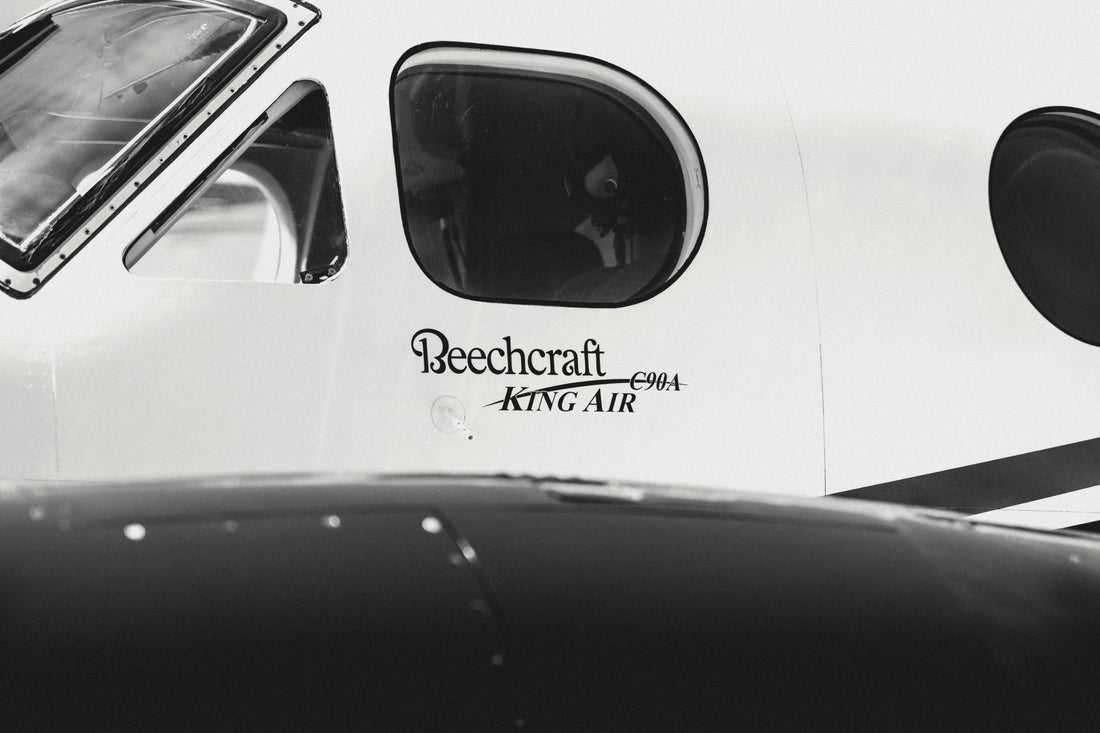
The History of the Beechcraft King Air 350: An Iconic Business Aircraft
Partager
For several decades, the Beechcraft King Air 350 has established itself as a true benchmark in the world of business aviation and special missions. Appreciated for its reliability, versatility, and remarkable performance, it has evolved without losing the essence of what makes it successful. In this article, we propose to retrace the history of this iconic aircraft, from its origins to today.
The origins of the King Air program
Historical context and birth of the Beechcraft King Air range
It all began in the 1960s, a pivotal era for aviation. Beechcraft, an already well-established manufacturer, decided to meet a growing demand for pressurized business aircraft that were faster than classic models. This led to the launch of the King Air 90, the first in the line, which was an immediate success.
Early successes and the evolution of the 200 series
Building on the success of the 90 series, Beechcraft continued its momentum with the King Air 100, then the 200 series, which quickly became a bestseller. The latter gained in power, capacity, and comfort, paving the way for a new generation of turboprops capable of competing with light jets over short distances.
The genesis of the King Air 350
Why develop a 350 version?
By the late 1980s, needs were evolving. Customers were looking for more space, more payload, and more modern systems. Beechcraft then decided to design a model derived from the King Air 300, but optimized: this was the birth of the King Air 350. The objective was clear: to offer a high-performance, reliable, and comfortable aircraft, while maintaining the flexibility of a turboprop.
Official launch and first deliveries
The King Air 350 was officially launched in 1988. It incorporated the DNA of its predecessors while integrating notable improvements. The first deliveries took place shortly after, and operators praised its flight qualities, extended range, and ability to operate on short or unprepared runways.
Technical characteristics of the King Air 350
Engine and performance
The King Air 350 is equipped with two Pratt & Whitney PT6A-60A engines, renowned for their robustness and reliability. It can reach a cruising speed of approximately 580 km/h and has a range of over 3,300 kilometers, allowing it to easily connect many destinations non-stop.
Cabin layout and passenger comfort
Its pressurized cabin accommodates up to 11 passengers, depending on the chosen configuration. The interior ambiance is refined, with a quiet, bright, and modular space. The King Air 350 is suitable for VIP transport as well as personnel transport or medical missions.
Technological evolutions over the years
Over the years, the King Air 350 has benefited from several updates. The introduction of the 350i version brings a Rockwell Collins Pro Line 21 digital cockpit, a significant reduction in cabin noise, and enhanced connectivity. More recently, the King Air 360 version offers even more automation and comfort.
Uses of the King Air 350 worldwide
Business aviation and VIP transport
The King Air 350 is primarily a versatile business aircraft. Many companies use it to transport executive management to hard-to-reach sites where a jet could not land. Its operating cost remains reasonable, making it an interesting alternative to jet aircraft.
Special missions: medical, surveillance, military
Thanks to its robustness, reliability, and modular cabin, the King Air 350 is also used for maritime surveillance missions, medical evacuation, aerial mapping, and military observation. It is particularly popular with public services, governments, and humanitarian organizations.
A popular aircraft among operators
Leasing companies, air forces, hospitals, and private operators worldwide continue to trust the King Air 350. It combines the economy of a turboprop with performance close to some light jets.
Discover the Beechcraft King Air 350 model
The King Air 350 today
Current production and variants
Still produced today by Textron Aviation, the King Air 350 has evolved into several versions, including the 350ER (Extended Range) for long missions, and the King Air 360, the latest version to date with a modernized cockpit and an advanced automation system.
An aircraft that remains competitive in the market
Despite increasing competition from light jets and upcoming electric aircraft, the King Air 350 remains a key player in the business aviation and special missions market. Its ability to evolve while maintaining its strengths is the key to its longevity.
Conclusion
The Beechcraft King Air 350 is much more than just a business aircraft. It is a versatile, reliable aircraft capable of adapting to a wide variety of missions. Since its launch, it has conquered skies worldwide and established itself as a lasting reference. And with modernized versions still in production, its future still seems well-defined.
Watch a presentation video of the Beechcraft King Air 350:
FAQ: We answer all your questions
What is the maximum speed of the Beechcraft King Air 350?
In cruise, the King Air 350 can reach approximately 580 km/h (310 ktas).
What is the difference between a King Air 350 and a King Air 360?
The King Air 360 is a more recent version, with more advanced avionics, an automated pressurization system, and improved cabin comfort.
How much does a new Beechcraft King Air 350 cost?
The price of a new King Air 350 varies depending on options, but it is around 8 to 9 million dollars.
Is the King Air 350 still in production today?
Yes, it is still produced, in the King Air 350i, 350ER, and 360 versions, by Textron Aviation.
What are the main missions of the King Air 350?
Business aviation, VIP transport, medical missions, surveillance, military transport, and aerial mapping.