
The Story of the B-52 Stratofortress: An Ageless Giant of the Skies
Partager
For over 70 years, the B-52 Stratofortress has crisscrossed the skies, faithfully serving despite technological advancements and passing decades. This strategic bomber designed by Boeing has become much more than just a military aircraft: it embodies an era, power, and an extraordinary capacity for adaptation. Let's dive into the fascinating history of this iconic aircraft, which continues to play a central role in the United States' arsenal.
The Origins of the B-52 Stratofortress
The history of the B-52 begins at the very start of the Cold War, when tensions between the United States and the Soviet Union became palpable. The US Air Force was then looking for an aircraft capable of carrying nuclear weapons over very long distances, without relying on bases close to the enemy.
It was in this context that Boeing proposed a long-range jet aircraft, intended to replace propeller bombers like the B-36 Peacemaker. The project took shape from 1948, with an initial mock-up that would quickly evolve into a revolutionary prototype. The first flight of a B-52 took place in April 1952, marking the beginning of an extraordinary career.
Early Versions and Their Evolution
The B-52 has seen numerous versions, from the very first A series to the current B-52H. Each new generation brought its share of modifications, whether in terms of propulsion, electronics, or weaponry.
The early versions were quite limited and often required adjustments between each series. It was mainly from the B-52G and B-52H that the aircraft reached technical maturity. The H version, introduced in 1961, is still in service today, proving the robustness of the basic concept. It features more fuel-efficient engines, improved avionics, and modernized defensive systems.
The B-52 in Action: Half a Century of Missions
The B-52 has not only been a symbol of nuclear deterrence. It has also been widely engaged in major conflicts, proving its ability to adapt to very different contexts.
During the Vietnam War, it was used for massive bombings (Operation Linebacker and Rolling Thunder), demonstrating its firepower. Later, it intervened in the first Gulf War, in Afghanistan, in Iraq, and even in more recent counter-terrorism operations. Its long range and its ability to carry a wide range of conventional or nuclear weapons make it a versatile strike tool.
Exceptional Longevity
What is most astonishing about the B-52 is its longevity. While most military aircraft are retired after a few decades, the B-52 continues to fly after more than 70 years of service. How can such a lifespan be explained?
First, its design was built to last: solid structure, reliable performance, and a modular design allowing for upgrades. Then, the aircraft has evolved with the times. It has been modernized several times to integrate the latest technologies, both in terms of navigation and weaponry. Today, the B-52 is capable of launching cruise missiles, deploying GPS-guided bombs, and even connecting to the new digital command systems of the American army.
The B-52 in Popular Culture
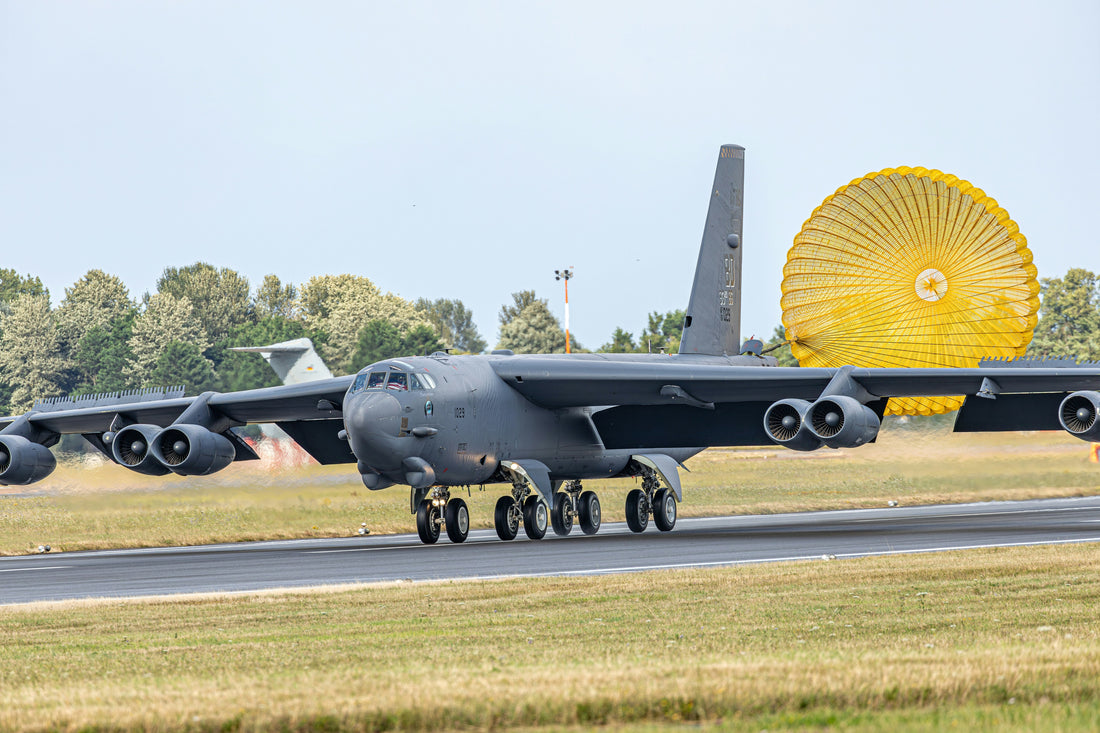
With its massive silhouette and eight engines aligned under its wings, the B-52 is immediately recognizable. It has often been featured in films, documentaries, and video games. We see it in Dr. Strangelove, Independence Day, and in games like Call of Duty or Ace Combat. It has become a visual icon of American air power.
Its affectionate nickname, "BUFF" for Big Ugly Fat Fellow, also shows how deeply rooted it is in the collective imagination of aviators and aviation enthusiasts.
What Future for the B-52 Stratofortress?
While some recent aircraft are already being retired from service, the B-52 is still far from retirement. The US Air Force has announced that it could remain in service until 2050, or even beyond. An ambitious modernization program is underway: new engines, digital cockpit, compatibility with new missiles, and integration into future weapon systems.
It is even envisioned that the B-52 could one day carry hypersonic weapons, proving that despite its age, it remains a major strategic asset. In other words, the aircraft is ready to spend several more decades in the sky.
Discover the B-52 Stratofortress model
Conclusion
The history of the B-52 Stratofortress is that of an extraordinary aircraft, which has spanned the ages, adapted to new threats, and remained relevant in a constantly evolving world. A true pillar of American air power, it continues to command respect for its reliability and longevity. While many thought it would have been replaced long ago, it proves every day that it still has its place in the modern military arsenal.
Watch a video on the history of the B-52 Stratofortress:
FAQ: We answer all your questions
What is the maximum speed of the B-52?
The B-52 can reach a speed of approximately 1,000 km/h (Mach 0.86), which remains relatively modest compared to some fighter jets, but sufficient for a strategic bomber.
Is the B-52 still in use today?
Yes, the B-52 is still in service with the US Air Force. It is regularly modernized and is expected to remain operational until 2050, or even beyond.
How many bombs can a B-52 carry?
It can carry up to 31 tons of munitions, including conventional bombs, guided bombs, mines, and even cruise missiles.
Why has the B-52 never been replaced?
Its reliability, payload capacity, ease of modernization, and relatively low operating cost explain why it remains indispensable, even in the age of drones and stealth aircraft.