
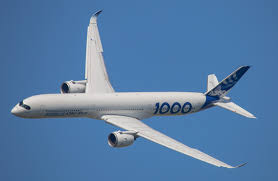
The History of the Airbus A350
Partager
The history of the Airbus A350, a modern airliner developed by Airbus, reflects the aviation industry's efforts to meet the growing demand for fuel-efficient long-haul jets.
Here are the key stages of its development:
1. Context and Genesis (2000s)
In the 2000s, Boeing introduced the 787 Dreamliner, a revolutionary aircraft for its fuel efficiency and extensive use of composite materials. Airbus, facing this competition, initially considered an improved version of its A330 called the A330-200Lite, but this idea was quickly abandoned in favor of an entirely new project: the A350.
2. Launch and Initial Design (2004-2006)
Airbus announced the A350 project in 2004, but airline criticism highlighted a lack of innovation compared to the Boeing 787. In response, Airbus completely revised the concept in 2006, introducing a new design with a structure largely made of composite materials (53% of the aircraft, including carbon fiber).
The A350 is designed to be lighter, more fuel-efficient, and quieter, while offering improved passenger comfort through features such as a wider cabin and better pressurization.
3. A350 Family Models
The A350 family includes two main variants:
- A350-900: Standard version, capable of carrying approximately 300-350 passengers with a range of 15,000 km.
- A350-1000: Extended version, carrying approximately 350-410 passengers, with a similar range.
An ultra-long-range variant, the A350-900ULR, enables non-stop flights such as Singapore-New York.
4. First Flights and Certification (2013-2014)
The A350 prototype made its first flight on June 14, 2013, in Toulouse, marking a key milestone in the program. After an intensive testing campaign, the aircraft received its certification from the European Union Aviation Safety Agency (EASA) in September 2014.
5. Entry into Service (2015)
The first A350-900 was delivered to Qatar Airways in December 2014 and entered commercial service in January 2015. The A350-1000, meanwhile, made its first flight in 2016 and entered service in 2018.
6. Technical Characteristics
- Engines: The A350 is powered by Rolls-Royce Trent XWB engines, specifically designed for this aircraft.
- Efficiency: Thanks to its aerodynamic design, composite materials, and modern engines, it consumes approximately 25% less fuel than previous generation aircraft.
- Comfort: The cabin offers more space, larger windows, and an LED lighting system that reduces jet lag.
7. Commercial Success
The A350 has achieved strong commercial success, with hundreds of orders placed by airlines worldwide, such as Air France, Lufthansa, Singapore Airlines, and many others. It is used for intercontinental flights, thanks to its exceptional range.
8. Competition and Prospects
The A350 directly competes with the Boeing 787 and, to a lesser extent, with the Boeing 777X. Thanks to its performance, it has become a key player in the long-haul aircraft market and is expected to remain a cornerstone of the global fleet for several decades.
The A350 illustrates the technological evolution and adaptation to environmental challenges of modern aviation.
Conclusion
The Airbus A350 represents much more than just an airliner: it is the symbol of a new era in commercial aviation. Designed to combine performance, comfort, and environmental respect, it embodies Airbus's response to the needs of a rapidly changing industry. Thanks to its cutting-edge technologies, fuel efficiency, and passenger comfort, the A350 has established itself as an essential pillar of modern long-haul transport. As climate and economic challenges redefine the future of the sector, the A350 confirms that innovation and sustainability can go hand in hand.
Watch a video about the history of the A350:
FAQ: We answer all your questions
When was the Airbus A350 launched?
The A350 program was officially launched in 2006 after a complete redesign of the initial project. The first flight took place in 2013, and commercial service began in 2015.
What is the difference between the A350-900 and the A350-1000?
The A350-1000 is an extended version of the A350-900. It can carry more passengers (up to 410 compared to 350 for the A350-900) while offering a similar range.
Which airlines use the A350?
Among the many airlines that have ordered or operated the A350 are Qatar Airways, Singapore Airlines, Air France, Lufthansa, British Airways, and many other major international carriers.
Why is the A350 considered fuel-efficient?
The A350 uses lightweight composite materials and highly efficient Trent XWB engines, which allows for a fuel consumption reduction of approximately 25% compared to older aircraft.
Is the A350 comfortable for passengers?
Yes, it offers a wider cabin, larger windows, adaptive LED lighting, and improved pressurization, which significantly enhances comfort and reduces the effects of jet lag.
What is the maximum range of the A350?
The A350-900ULR model can travel up to 18,000 km non-stop, allowing direct connections between very distant destinations like Singapore and New York.