
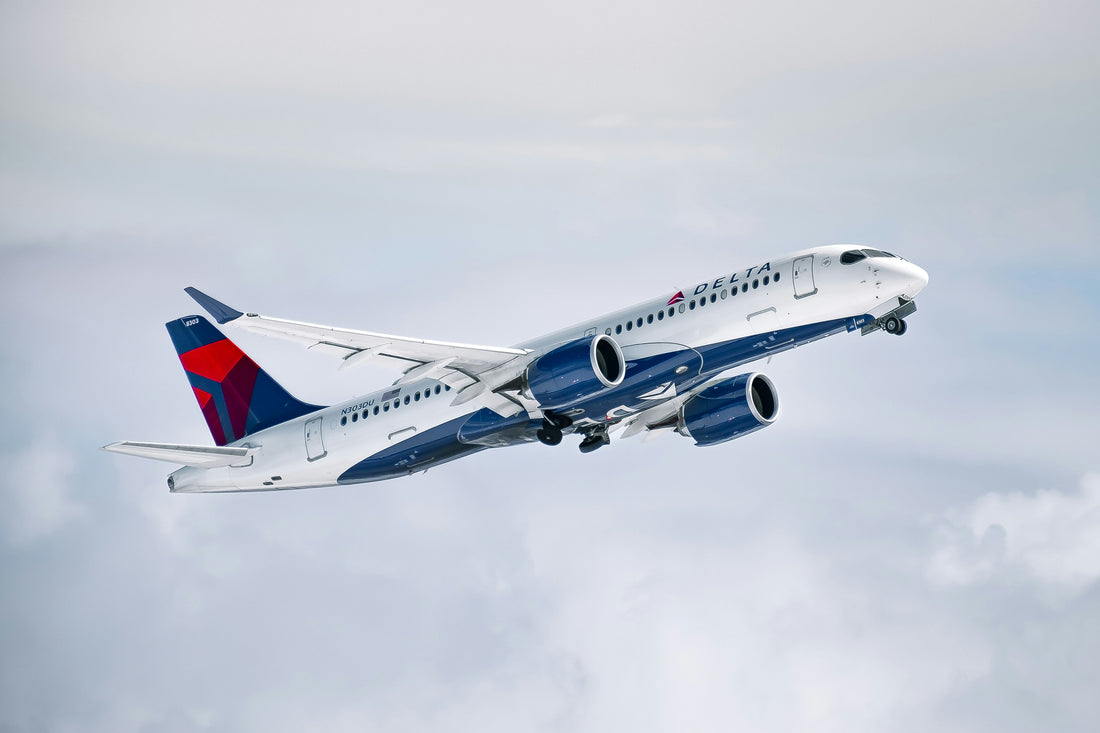
The A220 Story: From Bombardier to Airbus, the rebirth of a revolutionary aircraft
Partager
The A220 does not go unnoticed. A modern, quiet, and comfortable aircraft, it has established itself in just a few years as a benchmark in the commercial aviation market. However, its history is far from a smooth ride. Behind its current success lies a path fraught with pitfalls, a true aeronautical saga that saw an ambitious Canadian manufacturer hand over the reins to a European giant. Let's look back at the astonishing trajectory of this one-of-a-kind aircraft.
1. The origins of the CSeries project: Bombardier's ambition
In the early 2000s, Bombardier, a Canadian company already well established in the regional aviation sector with its CRJs, decided to make a big splash. Its idea? To create a brand-new aircraft capable of carrying between 100 and 150 passengers, while offering performance worthy of the largest single-aisle aircraft. This project, dubbed CSeries, clearly aimed to compete with Boeing and Airbus's most compact models.
The gamble was audacious: to design an aircraft from scratch, with a lighter structure thanks to the use of composite materials, new-generation engines, and a cabin designed for passenger comfort. A promising cocktail on paper... but costly and complex to achieve.
2. First flights, hopes and disappointments
The inaugural flight of the CSeries took place in September 2013. The aircraft immediately made a good impression: it was quiet, fuel-efficient, and the feedback from the first test pilots was very positive. However, behind the smiles, the program accumulated delays and significantly exceeded its planned budget.
Bombardier faced numerous challenges: technical problems, production delays, but also a mixed reception from the market. Few airlines dared to trust an unknown aircraft, from a manufacturer with little experience in this category.
Despite the qualities of the CSeries, Bombardier struggled to make the program profitable. The company's finances faltered, and the future of the aircraft became uncertain.
3. The decisive turning point: Airbus to the rescue
It was in 2017 that the situation changed. Airbus, sensing the potential of the CSeries but also Bombardier's difficulties, entered the game. The European manufacturer proposed an unexpected partnership: it acquired a majority of the program, without spending a dime, but in exchange for the promise to relaunch the aircraft under its wing.
In 2018, the CSeries officially became the Airbus A220. A name change, a new commercial strategy, and above all... integration into Airbus's vast industrial and commercial network. A second birth for the aircraft, this time with much stronger resources.
4. A new commercial life full of promises
As soon as it joined the Airbus family, the A220 began to attract attention. Airlines saw it as a high-performance, economical aircraft perfectly suited for low- or medium-density routes. Orders poured in: Delta Air Lines, Air France, Swiss, Air Canada, and many others quickly integrated the A220 into their fleet.
On the passenger side, feedback has been excellent. The cabin is spacious for an aircraft of this size, the windows are larger, and the Pratt & Whitney engines allow for a much quieter flight than on older aircraft.
Pilots also appreciate the flight comfort, maneuverability, and onboard technology.
5. The A220 today and tomorrow
Today, the A220 is offered in two versions:
-
The A220-100, shorter, ideal for regional routes
-
The A220-300, longer, suitable for denser flights
Its range, low operating cost, and comfort make it a strategic asset for many airlines. Airbus is even considering a third version, the A220-500, which would further increase the aircraft's capacity.
With over 1000 orders to its name (and this number continues to grow), the A220 has established itself as a major player in the single-aisle market. What was once a risky gamble has become a true commercial success.
Find an Airbus A220 model
Conclusion: an aircraft that knew how to bounce back
The story of the A220 is that of an aircraft that could have disappeared before even taking off. But thanks to Bombardier's daring, and then Airbus's support, it was able to reinvent itself and conquer the skies. Today, it embodies a new generation of aircraft that are cleaner, more comfortable, and better adapted to the challenges of modern aviation.
And you, have you ever had the opportunity to fly on an A220? Share your experience in the comments!
Watch a video about the history of the Airbus A220:
FAQ: our team answers all your questions
What is the difference between the A220-100 and the A220-300?
The A220-100 is shorter and can accommodate approximately 110 passengers, while the A220-300 can carry up to 150, with better efficiency on high-demand routes.
Why did Airbus take over the CSeries program?
Airbus saw in the CSeries a very promising aircraft, but hindered by Bombardier's lack of resources. By taking over the program, Airbus was able to integrate it into its global network and make it a commercial success.
Which airlines use the A220?
Among the main operators: Delta, Air France, Swiss, Air Canada, JetBlue, and soon several others worldwide.