
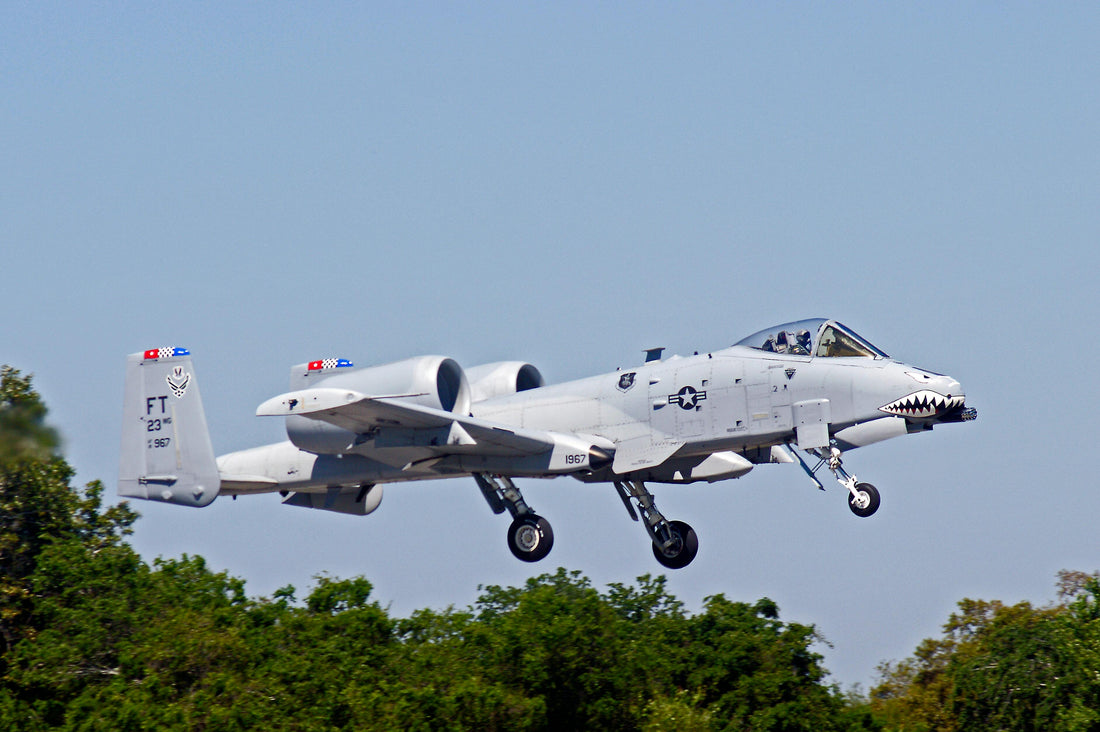
The History of the A-10 Thunderbolt: America's Formidable Attack Aircraft
Partager
Since its appearance in the 1970s, the A-10 Thunderbolt II, affectionately nicknamed the "Warthog", has held a special place in the world of military aviation. Designed to withstand the worst combat conditions and inflict heavy damage on enemy forces, it has become one of the most respected – and most feared – ground attack aircraft in history.
Behind its inelegant appearance lies a terrifyingly effective war machine, loved by pilots and feared by opposing armored vehicles. Let's look back at the fascinating history of this extraordinary aircraft.
Development Context: An Urgent Need During the Cold War
In the early 1970s, the United States faced a crucial strategic need: to have an aircraft capable of effectively supporting ground troops, particularly in the context of a potential confrontation with the Soviet bloc. The experience of the Vietnam War had shown the limitations of multi-role aircraft when faced with the realities of ground combat.
It was in this context that the A-X program ("Attack Experimental") was launched, aimed at finding a dedicated solution for close air support. Several projects were proposed, but the one from Fairchild Republic was chosen. The prototype gave birth to what would become the A-10 Thunderbolt II, in homage to the P-47 Thunderbolt of World War II, another champion of ground attack.
A Design Focused on Effectiveness and Survivability
Far from the aerodynamic lines of modern fighters, the A-10 impresses with its robustness. Everything in its design serves one purpose: to survive enemy fire while inflicting maximum damage.
An oversized cannon
At the heart of the aircraft is the famous GAU-8 Avenger, a 30 mm rotary cannon capable of firing up to 3,900 rounds per minute. This powerful weapon, specifically designed to destroy tanks, is so massive that the A-10 was literally built around it.
An aircraft built to take a beating
The Warthog is equipped with titanium armor around the cockpit, nicknamed the "bathtub." It can fly with a damaged wing, a single engine, or without hydraulics thanks to a mechanical backup system. Its design promotes simplicity and field reparability.
Engines in a raised position
Its two General Electric TF34 turbofan engines are placed above the fuselage to avoid debris during takeoffs from austere airstrips. Their low thermal signature also makes them less vulnerable to infrared-guided surface-to-air missiles.
The A-10 in Theaters of Operations
The A-10 saw its baptism of fire during the Gulf War in 1991. In the Iraqi desert, it played a decisive role in destroying hundreds of armored vehicles, artillery, and enemy positions.
Its effectiveness and ability to fly at low altitudes for extended periods made it a valuable ally for ground troops. Its presence reassured soldiers, who knew it could strike precisely, even in very tense situations.
Subsequently, it was heavily engaged in Afghanistan and Iraq, where it adapted to new forms of conflict, particularly asymmetric warfare. Despite its age, it proved that it remained relevant against irregular enemies in complex environments.
Modernizations and Uncertain Future
Over the years, the A-10 has benefited from numerous upgrades: a modernized cockpit with multi-function displays, a head-up display, latest-generation targeting pods, and even the integration of new types of weaponry.
But its future remains uncertain. The US Air Force has repeatedly attempted to retire the A-10, in favor of the F-35, a much more modern aircraft. However, each attempt has been hampered by strong opposition, particularly from military personnel themselves, convinced that the F-35 cannot fulfill the A-10's specific mission with the same effectiveness.
In 2025, several dozen A-10s are still in active service. Their withdrawal is planned to be gradual, but the debate remains lively: should such a reliable and proven aircraft really be retired?
A Legend in Popular Culture
Far from the runways of aerospace fashion, the A-10 has never sought to shine with its elegance. And yet, it has become an icon among aviation enthusiasts, thanks to its unique look, formidable effectiveness, and its famous cannon sound – that "BRRRRT" that makes air shows vibrate.
The Warthog is regularly featured in video games, films, and documentaries, a testament to its enduring popularity. It is also often highlighted at airshows, where its demonstrations impress young and old.
Among pilots, it enjoys an exceptional reputation. Those who have had the chance to fly it speak of an aircraft "made to protect", whose robustness provides a true sense of security.
Discover the A-10 Thunderbolt model
Conclusion
The A-10 Thunderbolt is much more than a warplane. It is a symbol of resilience, power, and effectiveness. Designed to meet very specific needs, it has adapted to evolving conflicts over the decades.
Its eventual withdrawal will mark the end of an era, but it will forever be etched in the history of military aviation as one of the most formidable attack aircraft ever built.
Watch a video about the history of the A-10 Thunderbolt:
FAQ: We answer all your questions
What is the A-10's primary mission?
The A-10 specializes in close air support, meaning direct support to ground troops by destroying nearby enemy forces.
Why is it nicknamed the Warthog?
Because of its ungraceful appearance and aggressive behavior, reminiscent of a warthog.
What is its main armament?
Its iconic weapon is the GAU-8 Avenger cannon, capable of firing armor-piercing rounds at a very high rate.
Is it still in service?
Yes, although nearing the end of its career, the A-10 is still used by the US Air Force, notably thanks to regular updates.
Can it be replaced by the F-35?
Technically, yes, but many believe that the F-35 cannot perform the A-10's missions with the same robustness or precision at low altitudes.