
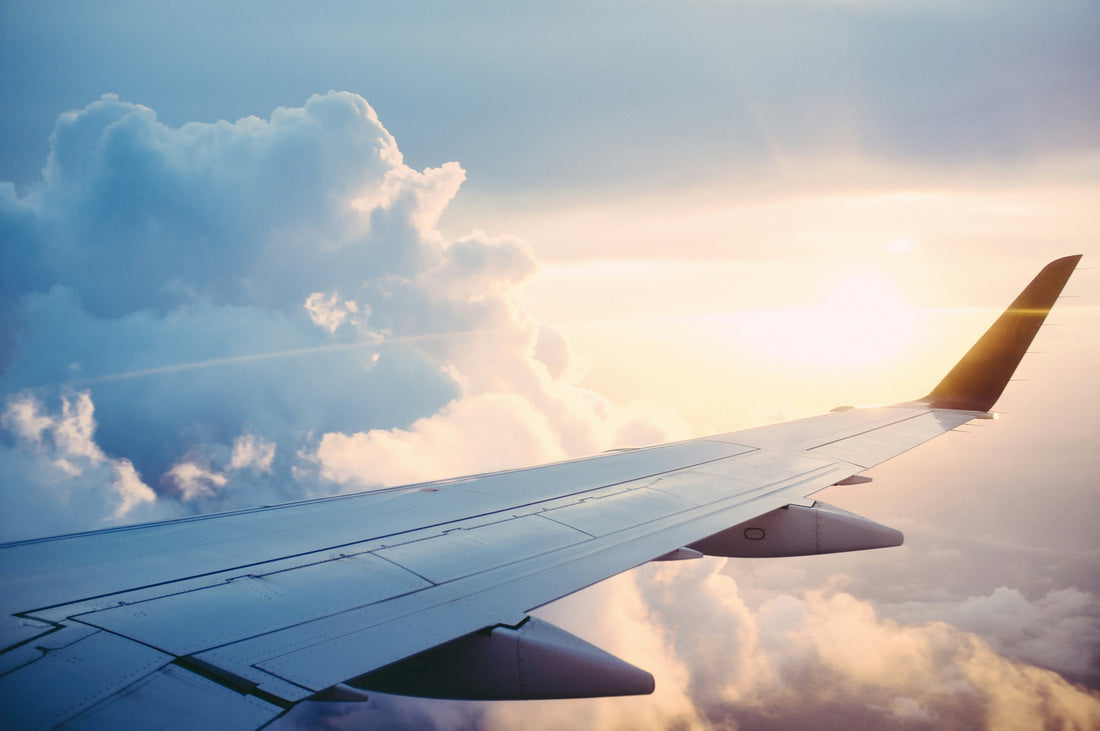
How does an airplane wing work? (Simple and clear explanation)
Partager
We’ve all watched a plane take off and wondered: “How can such a heavy machine stay in the air?” The answer lies largely in its wings. Their shape is no accident: they are specially designed to create a force called lift, which allows the plane to ascend.
Why do wings allow a plane to fly?
A wing works due to the speed of the air flowing around it. As the plane moves forward, air passes over and under the wing. Because the air moves faster over the top than the bottom, a pressure difference is created: the pressure is lower above and higher below. This imbalance pushes the wing upwards and makes the plane fly.
In summary: the faster the air flows over the wing, the more lift increases.
The particular shape of airplane wings
If you look at a wing in profile, you’ll notice it’s curved on top and flatter on the bottom. This shape is called an airfoil.
-
The upper part (extrados) is curved, which accelerates the air flowing over it.
-
The lower part (intrados) is flatter, where the air flows more slowly.
Another essential factor is the angle of attack, which is the wing’s inclination relative to the relative wind. The better the angle is adjusted, the more lift the wing generates… but if the angle is too steep, the air “stalls” and the wing loses lift.
The forces acting on a plane in flight
For a plane to fly, it’s not enough to just have wings. Four main forces act upon it:
-
Lift, created by the wings, which pulls the plane upwards.
-
Weight, due to gravity, which pulls the plane downwards.
-
Thrust, produced by the engines, which propels the plane forward.
-
Drag, which is air resistance and slows movement.
A plane can only fly if lift balances weight and if thrust overcomes drag.
Different types of wings and their specificities
Not all wings are alike. Their shape depends on the type of aircraft and its mission:
-
Straight wings are common on light aircraft and gliders, as they provide a lot of lift at low speeds.
-
Swept wings, angled backwards, equip most airliners and military aircraft to better handle high speeds.
-
Delta wings, triangular in shape, are typical of supersonic aircraft like the Concorde.
Devices that help wings fly better
Aircraft wings are equipped with small movable surfaces that facilitate certain flight phases:
-
Flaps, located at the rear of the wing, increase lift during takeoff and reduce speed during landing.
-
Leading edge slats, on the front of the wing, improve airflow when the plane is flying slowly.
-
Ailerons, placed at the wingtips, allow the plane to roll left or right.
These devices make flight safer and more maneuverable.
Concrete examples for better understanding
The operation of a wing can be compared to holding your hand out the window of a moving car. If you tilt your hand slightly, you feel a force pushing it upwards: this is the same logic as for an airplane wing.
Another natural example: birds. They have contoured wings that allow them to glide, flap, and create lift, just like airplanes.
Conclusion: the wing, the heart of an airplane's flight
Without its wings, an airplane could not leave the ground. Their shape, inclination, and accompanying devices transform the air into a true “invisible support.” Thanks to them, machines weighing several hundred tons can fly thousands of kilometers above our heads.
Watch a video about the characteristics of an airplane wing:
FAQ: We answer all your questions
How does a wing create lift?
By accelerating the air over the wing, which reduces pressure, while the pressure under the wing remains higher. This difference pushes the plane upwards.
Why are airplane wings curved?
The curvature allows air to flow faster over the wing, promoting the creation of lift.
What is the angle of attack?
It's the inclination of the wing relative to the relative wind. When properly set, it optimizes lift, but if too high, it leads to a stall.
What are the forces that allow a plane to fly?
Lift, weight, thrust, and drag, which must balance for the plane to remain in flight.
Do birds use the same principle as airplanes?
Yes, their wings are similarly shaped and exploit the same laws of aerodynamics.
The Most Unusual Airports in the World