
The Evolution of Cockpits: From Yoke to Glass Cockpit
Partager
The cockpit, the true heart of the aircraft, has undergone a spectacular transformation since the beginnings of aviation. From a rudimentary cockpit where the pilot only had a stick and a few instruments, we have moved to ultra-modern, fully digital cockpits, known as glass cockpits. This evolution tells not only the story of aeronautical technology, but also that of safety and ergonomics at the service of pilots.
The first cockpits: simplicity and manual flying
In the early days of aviation, cockpits were extremely simple. The pilot sat in an often rudimentary seat, sometimes even in the open air, and only had a control stick to fly the aircraft.
On-board instruments were limited to the essentials: an altimeter to measure altitude, a compass for orientation, and an airspeed indicator to show speed. The rest relied entirely on the pilot's feel and experience. It was a time when flying was almost more art than science.
The arrival of analog cockpits
As aircraft became more powerful and capable of flying higher and faster, cockpits had to evolve. This led to the appearance of so-called analog cockpits, where each parameter was displayed by a mechanical dial.
Gradually, the dashboard became filled with a multitude of instruments: artificial horizon, variometer, engine indicators, radios... To the point that pilots sometimes nicknamed these cockpits "Christmas tree cockpits", as the sheer number of lights and dials could seem overwhelming. This abundance of information made the pilots' work more complex and required constant vigilance.
The electronic revolution of the 70s and 80s
The 1970s and 1980s marked a decisive turning point with the arrival of electronics in aviation. The first CRT screens appeared in commercial aircraft, gradually replacing some mechanical instruments.
These new systems, combined with flight computers, helped reduce the pilots' workload. Displays became clearer and more ergonomic, with information grouped on a single screen instead of being scattered across dozens of dials.
The glass cockpit: a new era
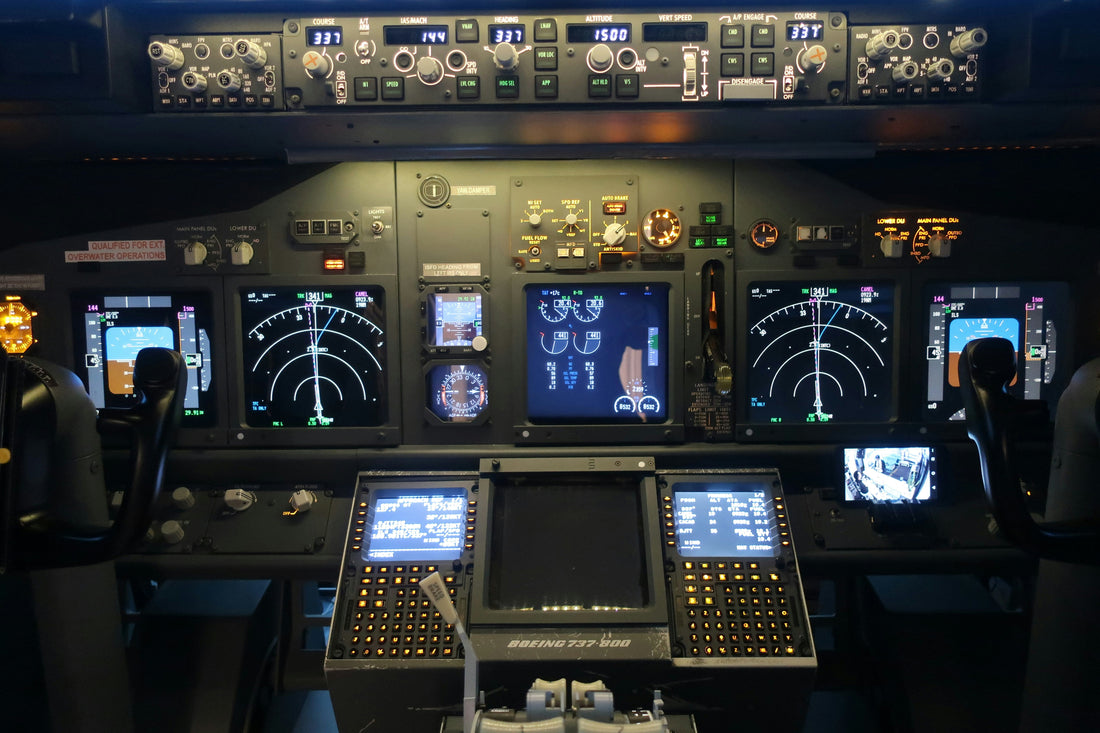
It was in the 1980s that the concept of the glass cockpit truly took hold, notably with aircraft like the Airbus A320 and the Boeing 757/767. Gone was the forest of dials: in their place were large multi-function screens that centralized all essential information.
The glass cockpit brings several major advantages:
-
Better readability of in-flight data.
-
The ability to customize screens according to the flight phase.
-
Increased reliability through electronic redundancy.
For pilots, this means less visual clutter and more time to focus on flight management and decision-making. It is a true revolution in the way of flying.
Modern cockpits and upcoming innovations
Today, modern aircraft cockpits go even further. They feature advanced navigation systems, head-up displays (HUDs), and even projects integrating artificial intelligence to assist pilots.
Augmented reality could soon display flight information directly on the canopy, making reading even more intuitive. At the same time, increasing automation raises an important question: how far will we go in reducing the role of human pilots?
Conclusion: a constantly transforming cockpit
From the control stick of the first aviators to the touchscreens of modern aircraft, the cockpit has always evolved to meet the needs of its time. Safer, more ergonomic, and more efficient, it remains a reflection of the evolution of aviation itself.
And while the cockpit of the future is still being invented, one thing is certain: behind the screens and technology, the pilot will always remain at the heart of the adventure of flight.
Watch a video on the evolution of aircraft cockpits:
FAQ: we answer all your questions
What is a glass cockpit in aviation?
A glass cockpit is a cockpit equipped with multi-function digital screens that replace the old analog dials.
Which commercial aircraft introduced the first glass cockpit?
The first airliners with glass cockpits were the Boeing 757 and 767, followed by the Airbus A320 which popularized this concept.
What are the advantages of a glass cockpit over analog instruments?
It allows for better readability, centralization of information, and a reduction in pilot workload.
Do modern cockpits make pilots less essential?
No, even as automation progresses, pilots remain essential for supervision, decision-making, and managing unforeseen situations.
What will future cockpits look like?
They will likely integrate more artificial intelligence, augmented reality, and even more automated systems.