
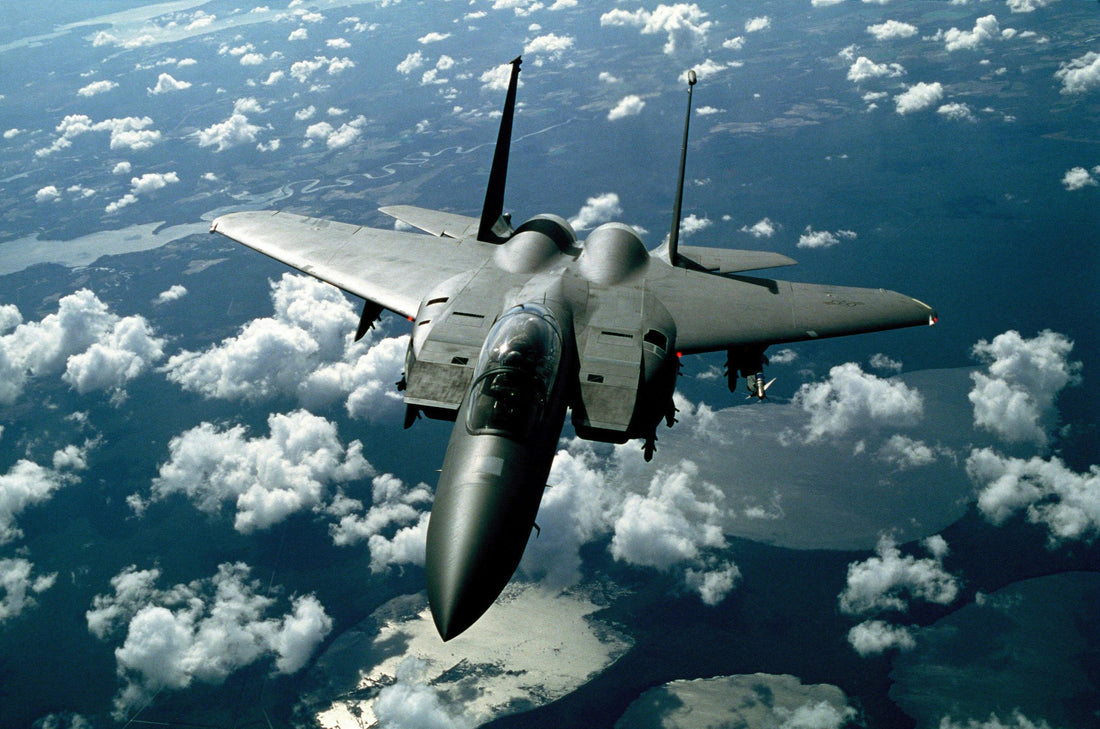
The Evolution of Fighter Jets: From World War I to Today
Partager
For over a century, fighter jets have undergone continuous transformation. In their early days, they were made of wood and canvas, slow, fragile, and lightly armed. Today, they are technological marvels capable of breaking the sound barrier, detecting targets invisible to the naked eye, and even operating semi-autonomously. The story of their evolution is also the story of conflicts, technical advancements, and military strategies. Let's go back in time together to better understand how these warbirds conquered the sky.
The beginnings: fighter planes during the First World War
When war broke out in 1914, aviation was still in its infancy. Planes were mainly used for observing enemy lines. But very quickly, pilots began attacking each other, first with personal weapons, then with machine guns mounted on the aircraft.
The real turning point came with the invention of the synchronization system, allowing firing through the propeller without breaking it. Aircraft like the Fokker E.III or the SPAD XIII then became formidable fighters. Aerial combat—the famous "dogfights"—became commonplace. Aces like the Red Baron entered legend.
The interwar period: experimentation and progress
After the armistice, engineers continued their research. Aircraft gained in power, speed, and maneuverability. Open-cockpit biplanes gradually gave way to metallic monoplanes.
The 1930s were a period of intense innovation. Engines were perfected, armament improved, and aerial tactics considered. The idea of a fighter as a central player in future wars gradually took hold in general staffs.
Second World War: the golden age of propeller fighters
The world conflict of 1939-1945 marked a spectacular acceleration in the development of fighter aircraft. The sky became a battlefield in its own right. Each nation developed its flagship models: the British Spitfire, the American P-51 Mustang, the German Messerschmitt Bf 109…
These planes could fly faster, higher, and were often equipped with cannons. Dogfights became more technical, tactics more elaborate. Air superiority became a decisive stake. And in 1944, an event would revolutionize aviation: the appearance of the first operational jet fighter, the Me 262.
The Cold War: speed, power, and technology
With the post-war period, a new race began—no longer against time, but against the ideological enemy. The United States and the Soviet Union engaged in a true technological war in the sky.
Supersonic jets became the norm. The F-86 Sabre confronted the MiG-15 in Korea, at speeds never before achieved. Onboard radars, air-to-air missiles, and fly-by-wire controls gradually transformed the fighter into an integrated weapon system.
From 1990 to today: versatility, stealth, and sophistication
From the 1990s onwards, the role of the fighter aircraft evolved further. It was no longer just about shooting down the enemy, but about carrying out several types of missions at once: interception, bombing, reconnaissance, electronic warfare...
Aircraft like the Rafale, the F-22 Raptor, or the Typhoon embody this new generation. They are fast, stealthy, packed with sensors, capable of communicating in real-time with other units. The pilot becomes an information manager, assisted by increasingly advanced embedded intelligence.
Discover our fighter jet models
And tomorrow? The future of fighter jets
The future is already taking shape. 6th generation fighter projects are underway. Europe is preparing the SCAF, the United States is working on the NGAD. These aircraft will likely be networked with drones, invisible to radar, and capable of hypersonic flight.
But beyond technology, a question remains: how long will human pilots be indispensable? Because as autonomous systems advance, the idea of a pilotless fighter becomes increasingly credible…
In summary
The history of fighter aircraft is the history of war seen from the sky. In a century, we've gone from fabric and wood to machines capable of managing dozens of targets simultaneously at Mach 2. One thing is certain: as long as airspace exists, humans will seek to dominate it. And fighters will continue to be one of its most impressive symbols.
2 comments
merci de votre site il est incroable est tres interresant
Merci d’avoir créé ce site il est très utile surtout pour le travail au collège