
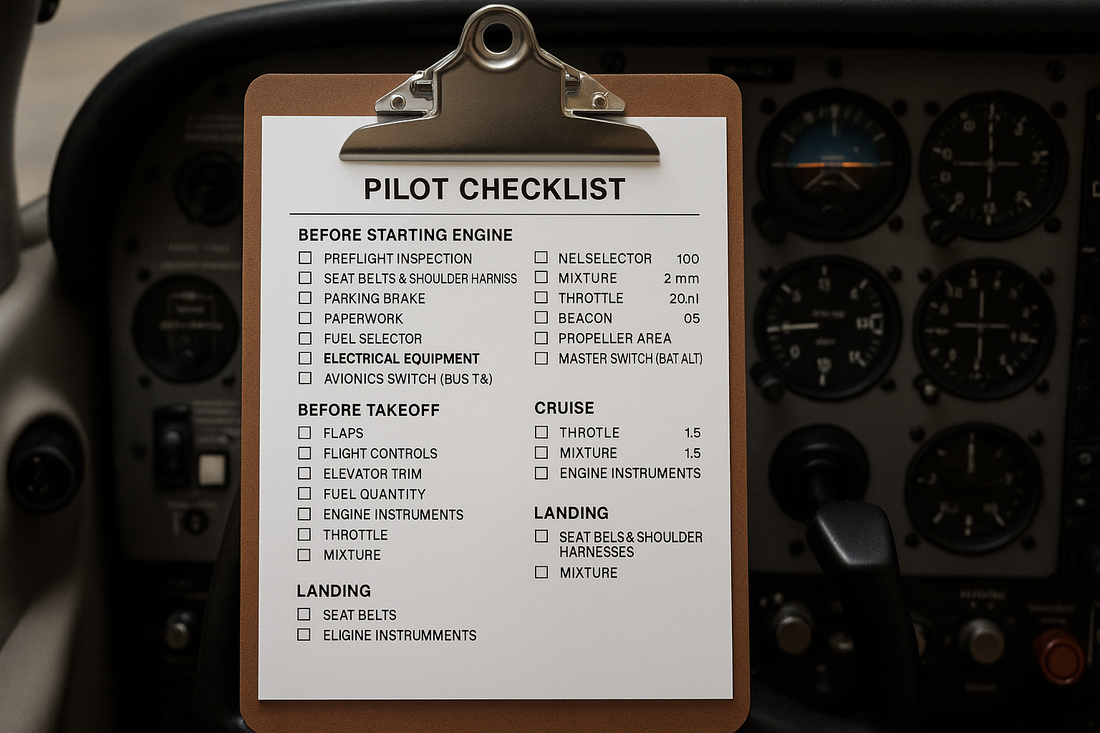
Pilots' secret checklist before each flight
Partager
Before each flight, behind the cockpit door, an unchanging ritual takes place. The pilots, focused and methodical, review a series of precise points: this is the famous checklist. A true backbone of aviation safety, it ensures that every detail is under control before takeoff. But what does this “secret checklist” really contain?
Why do pilots use a checklist?
In aviation, the checklist is not a mere formality; it is a golden rule. It allows for a point-by-point verification that all aircraft systems are operational before the flight.
Even the most experienced pilots adhere to it: human error remains the primary cause of incidents, and the checklist precisely serves to prevent it.
It is a blend of rigor, discipline, and humility. Regardless of the thousands of flight hours accumulated, every pilot knows that no detail should be left to chance.
The main stages of the checklist
The process often begins long before passengers board.
1. Exterior inspection (walk-around)
The co-pilot walks around the entire aircraft. He inspects the wings, landing gear, air intakes, tires, and ensures that no leaks or visual anomalies compromise the flight.
2. Cockpit setup
Inside, the captain and co-pilot activate electrical systems, test alarms, flight instruments, radio communications, and displays. This is where coordination between the two pilots is essential.
3. Pre-takeoff checks
Just before heading onto the runway, a final series of checks is performed: flaps, brakes, fuel, pressurization, altimeter... Nothing is left to chance.
What a pilot's checklist really contains
The checklist covers all essential aircraft systems:
-
Fuel and quantity on board
-
Flight instruments and navigation
-
Hydraulic and electrical systems
-
Flight controls (flaps, trim, rudders)
-
Radios and transponder
-
Doors, flaps, lights, and parking brakes
Each item is read aloud, confirmed by the co-pilot, then validated. This constant dialogue, called “call and response,” prevents oversights and enhances safety.
The checklist: a universal tool, but adapted to each aircraft
Even if the principle remains the same, each aircraft has its own checklist. A small Cessna obviously won't have the same checks as an Airbus A350.
On modern aircraft, checklists are now electronic (ECL): they are displayed on cockpit screens, and the systems themselves can flag an oversight or anomaly.
This evolution towards digital is in line with fly-by-wire, where technology assists the pilot without ever replacing them.
The human aspect behind the procedure
Beyond buttons and lights, the checklist highlights communication between pilots.
The Crew Resource Management (CRM) aims to foster listening, cooperation, and shared vigilance.
It is this human connection, far more than the machine, that guarantees flight safety. The checklist then becomes a common language, a ritual of mutual trust.
The most common errors… and how they are avoided
Even with the strictest procedures, oversights can happen. In the past, certain incidents have shown the importance of discipline in reading checklists: a simple forgotten switch or an unchecked calculation can have severe consequences.
Today, system redundancy, visual reminders, and communication between pilots help limit these errors to an almost zero level.
Moreover, every incident becomes a lesson, integrated into the training of crews worldwide.
Conclusion: the checklist, a ritual as precise as it is essential
This document, often perceived as a simple piece of paper or a formality, is in reality the silent guardian of aviation safety.
Every flight, whether short or long-haul, begins with these few minutes of absolute concentration where pilots, hand in hand with technology, ensure that everything is ready for a confident takeoff.
Watch a video on the importance of the checklist:
FAQ: We answer all your questions
Why do pilots have a checklist?
To ensure that all aircraft systems are operational and to prevent human errors.
What do pilots check before taking off?
They check instruments, fuel, flaps, communications, and aircraft configuration.
How long does a complete checklist take?
Between 10 and 20 minutes depending on the aircraft type and flight conditions.
Are checklists the same for all aircraft?
No, each aircraft model has its own checklist adapted to its systems and complexity.
What happens if an item on the checklist is not validated?
Takeoff is delayed until the issue is resolved. Safety always comes first.
Fly-by-wire aircraft: Revolution or calculated risk?
The different types of aircraft engines: piston, turbine, jet