
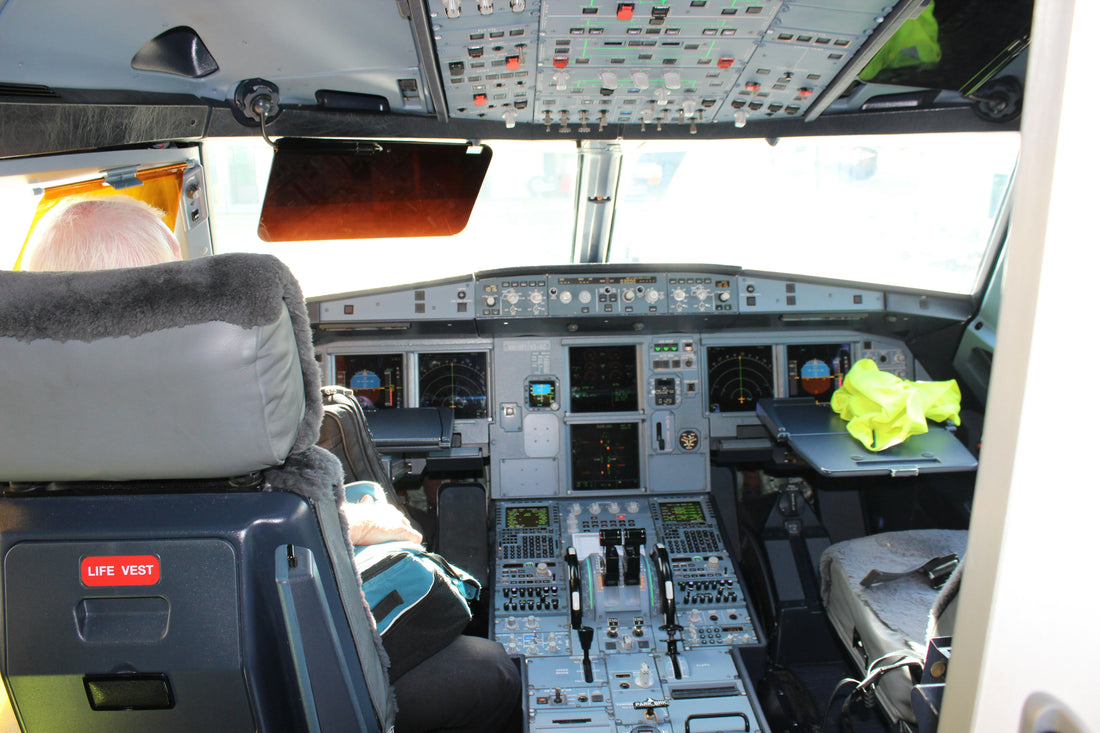
Fly-by-wire aircraft: revolution or calculated risk?
Partager
When we talk about modern aviation, one term often comes up: fly-by-wire. Behind this somewhat technical name lies a true revolution. This system, which replaces old mechanical controls with electrical signals, has transformed how an aircraft is flown. But some still wonder: has this technology made flying safer, or more dependent on computers?
What is fly-by-wire?
Traditionally, pilots controlled aircraft using cables, pulleys, and hydraulic actuators directly connected to the control surfaces. Every movement of the stick physically moved the control surfaces.
With fly-by-wire, everything changed. Now, when the pilot pulls the stick or moves the rudder pedals, the commands are converted into electrical signals. These signals pass through flight computers, which interpret the orders and then transmit instructions to the control surfaces.
The result? More precise, smoother, and above all, smarter piloting.
A true revolution in piloting
The fly-by-wire system has enabled the design of lighter aircraft, as heavy mechanical systems have been replaced by electrical wires. This reduces weight, improves fuel consumption, and simplifies maintenance.
But most importantly, this technology has added an active safety layer. Computers constantly monitor the pilot's actions and prevent certain errors. For example, they prevent an aircraft from exceeding its critical angle of attack, which could cause a stall.
In other words, fly-by-wire does not take control away from the pilot: it acts as an aid, a silent guardian ensuring flight safety.
Pioneers of fly-by-wire in civil aviation
The first civil aircraft to integrate a partial fly-by-wire system was the Concorde in the 1970s. This technological marvel already used electrical controls for certain surfaces, a feat for its time.
But it was the Airbus A320, launched in 1988, that marked a historic turning point. It was the first fully fly-by-wire airliner, with flight computers capable of automatically correcting piloting errors.
Airbus and Boeing then adopted two different approaches:
-
At Airbus, computers limit pilot actions to stay within a safe flight envelope.
-
At Boeing, the system assists the pilot but allows them to go beyond if necessary.
Two different visions, but a common goal: safety and performance.
A calculated risk?
Replacing mechanical systems with electronics initially raised concerns. What happens if a computer fails?
The answer can be summarized in one word: redundancy.
Fly-by-wire aircraft have several independent flight computers, powered by different electrical and hydraulic sources. If one fails, the others immediately take over.
Some rare incidents, such as Air France Flight 447 in 2009, reignited the debate on the pilot's role versus the machine. But these events primarily led to improvements in software, training, and human-machine interfaces. Today, fly-by-wire is considered one of the most reliable systems in modern aviation.
The future of assisted piloting
The fly-by-wire system has paved the way for a new generation of connected and intelligent aircraft. With artificial intelligence, future aircraft could analyze even more parameters in real-time, anticipate critical situations, and even land autonomously.
This does not mean that pilots will disappear. Their role is evolving: they are becoming more like system supervisors, ensuring the safety and smooth running of the flight.
Automation continues, but human presence remains essential.
Conclusion: fly-by-wire, a controlled revolution
The fly-by-wire system has revolutionized aviation, making piloting safer, smoother, and more efficient. While it raised questions at its inception, it has now become a pillar of aviation safety.
More than just a technological advance, it is a symbol: that of modern aviation, intelligent and human at the same time.
Watch a video about the fly-by-wire system:
FAQ: We answer all your questions
What is the fly-by-wire system?
It's an electrical flight control system where pilot commands pass through computers before being executed by the control surfaces.
What are the advantages of fly-by-wire?
It allows for more precise piloting, enhanced safety, and reduced aircraft weight.
Does fly-by-wire make planes safer?
Yes, because it prevents certain piloting errors and ensures redundancy in case of failure.
What is the difference between Airbus and Boeing?
Airbus automatically limits pilot actions to stay within safety margins, while Boeing allows the captain more freedom.
Have there been any accidents related to fly-by-wire?
Very few, and the rare incidents have primarily led to improvements in systems and crew training.
What is lift? The explanation for non-scientists
The different types of aircraft engines: piston, turbine, jet