
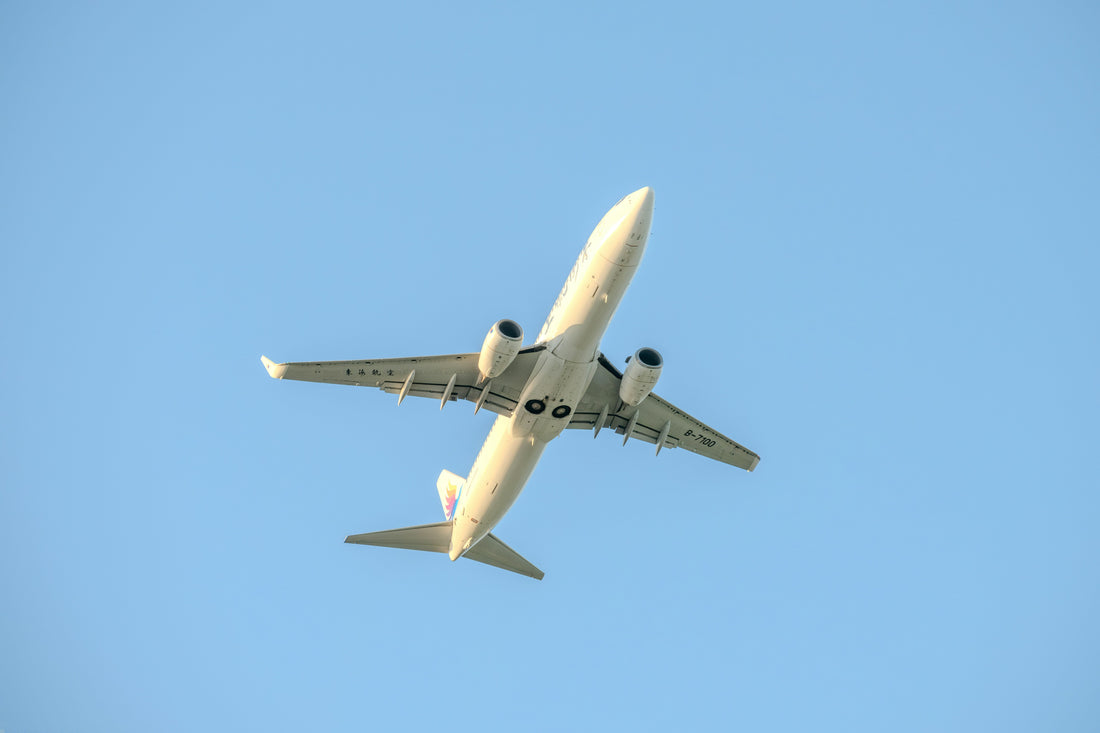
How high does an airliner fly?
Partager
When you see a plane drawing a white line in the sky, it's hard to imagine how high up it actually is. Yet, these giants of the air fly at very specific altitudes, chosen for technical, economic, and safety reasons.
So, how high does a commercial airliner fly? Why does it fly so high? And do all planes follow the same rules?
In this article, we answer all these questions to give you a glimpse behind the scenes of the sky.
What is the average altitude of an airliner?
The vast majority of airliners fly at a so-called “cruising altitude” located between 9,000 and 12,000 meters, or approximately 30,000 to 40,000 feet. This range offers ideal conditions for efficient flight.
To be more precise:
-
An Airbus A320, used for short or medium-haul flights, generally flies between 30,000 and 38,000 feet.
-
A Boeing 777, intended for long-haul flights, easily reaches 35,000 to 43,000 feet depending on the load and distance to be covered.
Figures vary depending on the aircraft model, its takeoff weight, weather conditions, and the flight plan established with air traffic controllers.
Why do planes fly so high?
It's not just a coincidence. This flight altitude is the result of precise calculation aimed at optimizing aircraft performance. Here's why flying high is an advantage:
Less air resistance
The higher the plane climbs, the lighter the air becomes. At 35,000 feet, the atmosphere is much less dense than at ground level, which allows the plane to reduce air resistance. The result: it consumes less fuel for an equivalent speed.
Better engine efficiency
Jet engines are designed to be more efficient at high altitudes. They thus reach their optimal performance between 30,000 and 40,000 feet.
Less turbulence
Most turbulence due to weather occurs at low to medium altitudes. In cruise, the aircraft generally flies above clouds and storm areas, offering a more stable and comfortable flight.
Air traffic organization
At high altitude, airspace is better structured and segmented by levels, which facilitates the management of simultaneous flights and reduces the risk of collision.
How is altitude chosen during a flight?
Flight altitude is not chosen randomly. It depends on a set of technical and regulatory factors.
The role of air traffic controllers
It is the air traffic control center that assigns the altitude to each aircraft based on the flight plan, traffic, and air circulation conditions.
Flight Levels
In aviation, we speak of flight levels (e.g., FL350 for 35,000 feet). These levels are spaced 1,000 feet apart from each other, to ensure sufficient vertical separation between aircraft.
Direction of flight
There is a rule called the semi-circular rule:
-
Planes flying eastbound climb to odd altitudes (FL330, FL350, FL370…).
-
Those flying westbound fly at even altitudes (FL340, FL360…).
Other factors
The weight of the aircraft, weather, wind, remaining distance, and engine performance are all elements that influence the chosen altitude for each phase of the flight.
Flight altitude vs. true altitude: what's the difference?
It is important to distinguish between several notions of altitude in aviation:
-
True Altitude: actual height above sea level.
-
Pressure Altitude (Flight Level): measured according to a standard atmospheric pressure (1013 hPa). This is what is used in cruise.
-
Density Altitude: useful for calculating engine performance, influenced by temperature and pressure.
In summary: an aircraft can fly at FL350 (level 350), which corresponds to 35,000 feet measured relative to a standard pressure, even if the actual atmospheric conditions of the day may cause the true height to vary.
Can one fly higher or lower?
Technical limits
Each aircraft has an operational ceiling that must not be exceeded, at the risk of compromising safety and maneuverability. For example, a Boeing 737 is limited to 41,000 feet, while a Gulfstream G650 (private jet) can reach 51,000 feet.
Low-altitude flight
Sometimes a plane remains lower:
-
In case of complex weather at altitude
-
In case of technical faults (e.g., depressurization)
-
At the request of air traffic control
And higher?
Only certain military aircraft or experimental aircraft (like the Concorde back then) could fly above 60,000 feet. These heights remain inaccessible for conventional airliners.
Find the best aircraft models
In summary
Airliners generally fly between 9,000 and 12,000 meters altitude, or around 35,000 feet, to optimize their fuel consumption, avoid turbulence, and streamline air traffic.
Next time you look up at the sky, you'll know exactly what's going on up there!
Watch a video on aircraft flight altitude:
FAQ: We answer all your questions
What is the maximum altitude for an airliner?
Most modern airliners do not exceed 43,000 feet, although some private jets can fly higher.
Do all planes fly at the same altitude?
No. Altitude depends on the model, route, weight, and air traffic. Two planes on the same route will never be at exactly the same altitude for safety reasons.
Why not fly lower to see the landscape?
At low altitude, air resistance is stronger, turbulence is more frequent, and fuel consumption is much higher. It would therefore be inefficient and uncomfortable.
How high do military aircraft fly?
Certain military aircraft like fighters or spy planes (e.g., U-2) can climb to over 70,000 feet, but these are special cases.
Does altitude affect passengers?
In the cabin, pressure is regulated to correspond to an altitude of approximately 2,400 meters, which prevents the negative effects of a too-high actual altitude on the body.
Find the best of aviation news
4 comments
Super. Explications Claires, nettes et précises. Grand merci.
Cordialement Roland
Merci pour les précision.
J’en veux encore plus.
commentaire bien détailler, et permet de mieux comprendre le vol d’un avion
merci
Je souhaite voyager chez moi natale et de parents biologiques au 6 cieux .